AI Disruption, Capability Development, Human Potential, Insights
Let’s start with a confession: I used to think I was immune to my own nonsense. Turns out, AI is the friend who calls you out, lovingly, but with receipts.
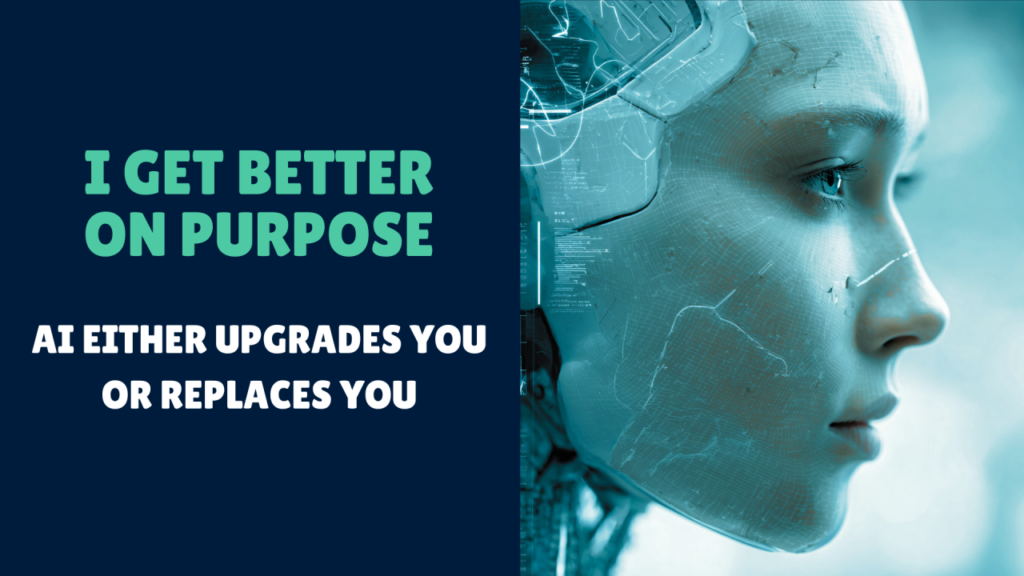
Insight: I am a better human when I think with AI. Not because it makes me “faster,” but because it makes me harder to fool, especially by myself. ChasmSherpa (my personally trained and optimized ChatGPT) pushes my ideas through friction. It exposes the fuzzy parts. It forces clean sentences, clean logic, and clean intent.
Consequence: If I do not deliberately use AI augmentation, I drift into confidence as a strategy. That works right up until the moment reality asks for receipts. In 2026, that is the moment careers stall, teams misfire, and leaders discover their digital workforce was built on assumptions.
Proof: I can see the difference in my work. With AI, I catch gaps earlier, write more clearly, make fewer unforced errors, and document decisions as I go. That is the real upgrade. It turns good instincts into repeatable outputs. And AI does not forget. It’s easily auditable to see where it has helped me and added value over tens of thousands of prompts in just the last 12 months.
Next step: Run a simple test this week. Do one real deliverable with AI, then do a comparable one without it. Track time, quality, clarity, and mistakes. That delta is your personal advantage, or your warning light.
Skills Without Proof Breaks
Quick reality check: Everyone says they have skills. But if you can’t prove it, does it even count? This isn’t just about spicing up your LinkedIn headline; it’s about passing the ultimate audit when it matters most.
Insight: Skills claims without competency evidence are now a workforce resilience and capability assurance problem, not a personal branding problem. The issue is not your LinkedIn headline. The issue is whether an organization can prove capability when it matters, under pressure, under audit, under incident response, under delivery deadlines.
Consequence: When “we think we have the skills” becomes the operating model, you get invisible skills gaps, fragile execution, and unmanaged automation risk. Leaders cannot govern what they cannot measure. Teams cannot improve what they cannot verify. Also, your toaster is not plotting a takeover. It is just quietly getting promoted.
Proof: SFIA (Skills Framework for the Information Age) is an objective skills language, a skills taxonomy that defines skills and levels in a way humans can apply consistently. SkillsTX turns that language into skills intelligence by maintaining an evidence-based skills inventory, mapping real work outputs to skills, and enabling skills validation. APMG strengthens this with independent assessment and credibility. The result is a vendor-neutral, governance-grade system of record, designed for accountability, not badge fluff.
Next step: Stop collecting titles and start collecting proof. Capture artifacts, decisions, outcomes, and feedback. Map them to SFIA levels in SkillsTX. Turn “I can do this” into “Here is the evidence.” As a first step, take a free SFIA assessment from SkillsTX to benchmark your current skills and see where your evidence stands.
Imagine playing a home game without knowing the score or even the rules. That’s what skipping self-measurement feels like in the AI era. Let’s not hand the scoreboard to the robots.
Insight: Home field advantage means you know your augmentation delta and your replacement risk. If you do not measure how AI changes your performance, you are letting emerging tech define your value, your pace, and your future.
Consequence: People who can prove they get better with AI will compound faster. People who cannot will be compared to agents, automation, and robotics, and that comparison will not be sentimental. The market does not punish you for being human. It punishes you for being unverified.
Proof: My edge is not that I use AI. My edge is that I document what improved, what stayed hard, and where human judgment still wins. That creates defensible capability, not vibes. It also creates a cleaner story for leaders: fewer assumptions, more assurance, better decisions.
Next step: Build a weekly habit: one AI-assisted win, one miss, one lesson, one piece of evidence logged. Update your SFIA profile, track skill gaps, and keep your system of record up to date. If you don’t have an evidence-based system of record, you can complete a free SFIA9 assessment here: https://bit.ly/SFIAAssessment
Proof is the only safe advantage.
AUTHOR NOTE: Reproduced with thanks to John Kleist III, Chief Growth and Alliances Officer for SkillsTX and author of Digital Talent Strategies, a popular newsletter on LinkedIn. John is a LinkedIn “Top Voice” and a Human Capability Detective, turning talent assumptions into defensible evidence. If you believe humans still matter in the future of work, we are already aligned. If you want to prove it, let’s talk.