
What Is Skills Slop?
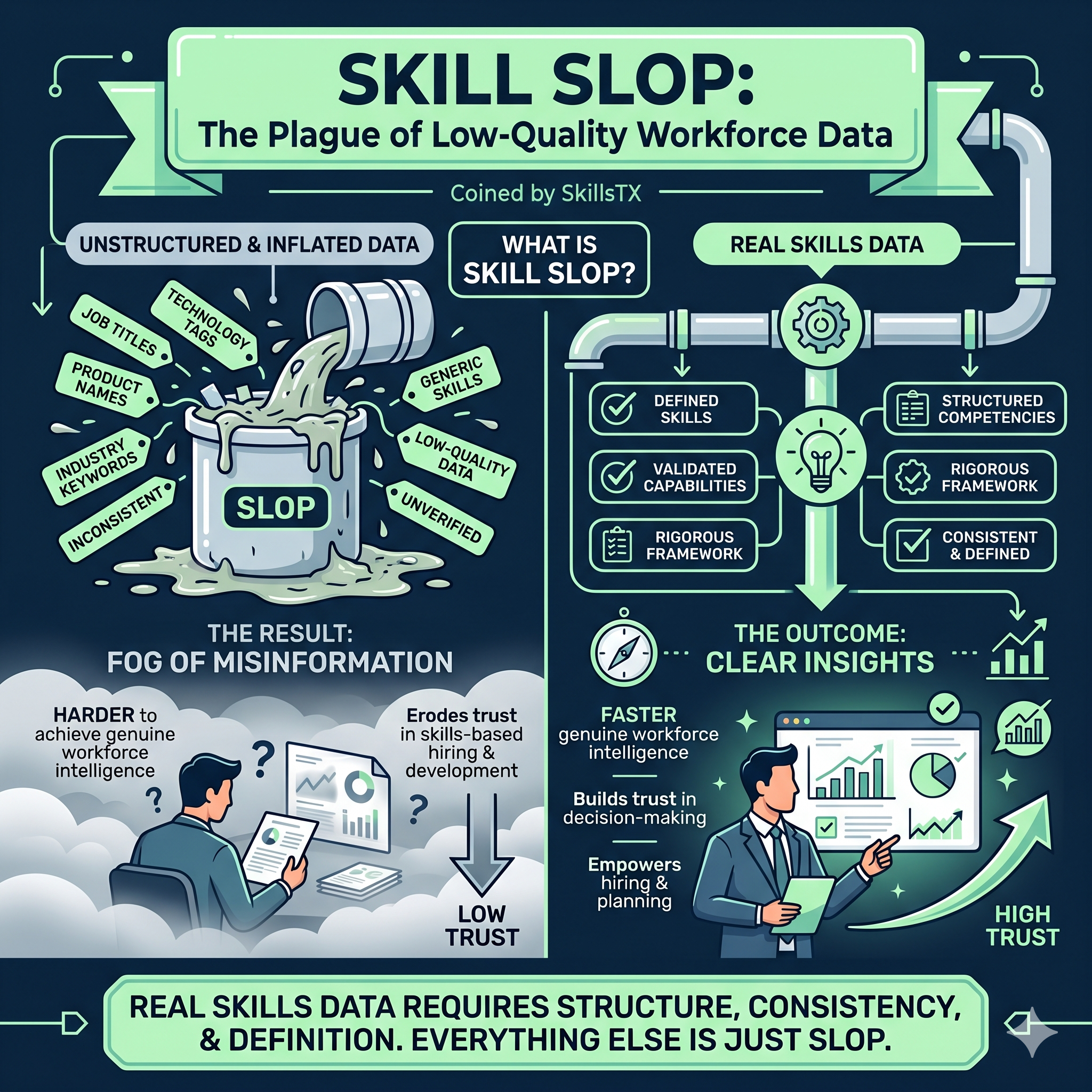
The term “Skills Slop” was coined by SkillsTX to describe the proliferation of low-quality, inflated, and inconsistent skills data embedded in workforce and talent platforms. It is the workforce technology equivalent of “AI Slop,” the well-known phenomenon of low-quality, mass-produced AI-generated content that prioritizes volume over value, flooding digital environments and eroding trust.
“AI Slop is digital content of low quality that is produced usually in quantity by means of artificial intelligence.” — Merriam-Webster Dictionary, 2025 Word of the Year.
Skills Slop is the same problem applied to workforce data. It emerges when HRIS (Human Resource Information Systems) and HXM (Human Experience Management) platforms claim to offer comprehensive skills libraries — sometimes listing tens of thousands of “skills” — when in reality the vast majority of those entries are:
- Technology tags and software product names (e.g., “Microsoft Excel”, “Salesforce”, “Tableau”)
- Job titles and role labels (e.g., “Product Manager”, “Scrum Master”)
- Industry certifications and vendor credentials (e.g., “AWS Certified Solutions Architect”, “PMP”)
- Industry jargon and buzzwords (e.g., “Digital Transformation”, “Agile Mindset”)
- Keyword fragments scraped from job postings or resumes without a structured definition.
These entries are not skills in any meaningful sense. They lack the rigor required to describe what a person can actually do, at what level of proficiency, and in what context. They are labels; relabelled as capabilities and sold as workforce intelligence.
Why Does Skills Slop Exist?
The Commercial Incentive
The HR technology market is highly competitive. Vendors face intense pressure to demonstrate breadth of coverage in procurement processes. A platform claiming 50,000 skills appears more comprehensive than one offering 5,000; regardless of the quality, consistency, or utility of those entries. This commercial dynamic rewards volume over rigor, creating a race to inflate skills libraries with any term loosely associated with work.
The result is a procurement illusion: organizations select platforms based on headline numbers that do not reflect the quality of underlying data. Skills Slop is, in part, a feature of vendor incentives misaligned with customer outcomes.
The Data Sourcing Problem
Many generic HRIS and HXM skills libraries are populated by scraping job advertisements, resumes, LinkedIn profiles, and online content. This approach produces large datasets quickly but inherits all the inconsistencies, duplications, and noise from those source materials. The same capability may appear dozens of times under different names. Certifications are listed alongside genuine skills with no distinction. Proprietary software products appear as transferable competencies.
Without a structured taxonomy, a principled framework that defines what a skill is, how it differs from a tool or a credential, and how skills relate to one another, the resulting library is not a skills framework. It is a word cloud.
The Absence of Proficiency Context
Even where entries in a skills library might be considered genuine skills, Skills Slop is compounded by the absence of proficiency context. Knowing that an employee “has” a skill tells an organization almost nothing useful. What matters is:
- At what level can they perform? (novice, practitioner, expert)
- In what context have they demonstrated that capability?
- How does their proficiency compare to what the role requires?
- How does that skill relate to adjacent capabilities?
A flat list of skill labels, however long, cannot answer any of these questions. Skills Slop does not just provide bad data. It provides data that feels useful but actively misleads decision-making.
Certificates Are Not Skills
One of the most pervasive forms of Skills Slop is treating industry certifications as a proxy for skills. Certifications are common in technology, project management, finance, and many other domains. Platforms routinely include entries such as:
- AWS Certified Solutions Architect
- Project Management Professional (PMP)
- Certified Information Systems Security Professional (CISSP)
- Google Analytics Certification
Holding a certification confirms that a person passed an exam at a point in time. It does not describe what they can actually do, at what level of depth, or how that capability manifests in practice. A certification is an evidence artifact; it may support a claim to a skill, but it is not the skill itself. Including certifications as skills inflates library counts, muddies capability data, and makes it impossible to distinguish between demonstrated competence and examination success.
What are the Consequences of Skills Slop?
Flawed Hiring Decisions
When skills data lacks rigor, hiring decisions are made on a foundation of noise. Job requirements expressed in Slop terms attract candidates who match keywords but not capabilities. Automated matching systems surface candidates based on label alignment rather than genuine fit. Organizations hire for terms they cannot define and assess candidates against criteria they do not understand.
Wasted Learning and Development Investment
Skill gap analysis based on SLOP data produces unreliable results. If the skills identified as “missing” are poorly defined or conflated with tool familiarity and certifications, the learning interventions designed to close those gaps will be misdirected. Organizations spend significant budget on L&D programs targeting phantom gaps while genuine capability deficiencies go unrecognized.
Workforce Planning Built on Sand
Strategic workforce planning requires reliable data about current organizational capability and future requirements. Skills Slop corrupts both sides of this equation. The current capability data appears inflated and inconsistent. Future requirements, expressed in the same Slop terms, cannot be meaningfully compared to the current supply. The result is workforce planning that provides false confidence rather than genuine intelligence.
Erosion of Trust in Skills-Based Approaches
Perhaps the most significant long-term consequence of Skills Slop is the erosion of confidence in skills-based talent management as a discipline. When organizations invest in skills frameworks and platforms and then find that the data does not support meaningful decisions, they conclude that skills-based approaches do not work. The failure is attributed to the concept rather than the data quality. Skills Slop undermines an approach that, when implemented with rigor, genuinely transforms workforce performance.
The workforce does not have a skills gap problem. It has a Skills Slop problem. The gap is real, but it cannot be closed with data that cannot define it.
What is the SkillsTX Solution?
SkillsTX was purpose-built to solve the Skills Slop problem. Every design decision, from the choice of foundational framework to the platform’s architecture, reflects a commitment to skills, data quality, consistency, and practical utility.
Built on SFIA 9: The World’s Most Trusted Skills Framework
At the foundation of SkillsTX is SFIA 9 (Skills Framework for the Information Age, version 9), the globally recognized standard for defining and measuring digital, technology, and broader workforce skills. SFIA 9 provides:
- 147 clearly defined skills, each with a structured description and seven proficiency levels
- A consistent proficiency scale from Level 1 (Follow) to Level 7 (Set Strategy, Inspire, Mobilize)
- 16 Generic Attributes covering the behaviors and qualities that underpin professional effectiveness
- A governance body ensuring the framework evolves with industry without compromising integrity.
SFIA is not a word cloud. Each skill entry is a defined construct with a name, description, and clear delineation from adjacent skills. The proficiency levels provide the context that flat skill lists cannot; they describe not just what someone does, but how autonomously, at what level of complexity, and with what level of accountability.
By building on SFIA 9, SkillsTX eliminates the fundamental ambiguity that produces Skills Slop. Every skill in the SkillsTX platform has a definition. Every proficiency level has a description. Every assessment produces a result that means something.
AI Readiness Built on Structured Skills Data
SkillsTX has extended the SFIA 9 framework to address one of the most pressing workforce questions of the current era: AI Readiness. Through the AI eXplorer service, SkillsTX has mapped AI-specific attributes across all 147 SFIA 9 skills and all 16 Generic Attributes and Behaviors, resulting in a structured taxonomy of 432 unique AI-relevant attributes, each with descriptions and proficiency anchors.
This is the antithesis of Skills Slop. Rather than adding “Artificial Intelligence” as a tag to a skills library, SkillsTX provides a structured, role-specific view of how AI capability manifests across different functions and levels of proficiency in practice. Organizations can assess not just whether their people “have AI skills” but where, at what depth, and where the genuine gaps lie.
The SkillsTX Product Portfolio
SkillsTX delivers workforce intelligence through an integrated suite of products, each designed to turn rigorous skills data into actionable outcomes:
| Product | Purpose |
| TalentTX | Core workforce skills intelligence platform. Enables organizations to build, assess, and manage skills profiles across the workforce against SFIA 9, producing validated capability data at individual, team, and organizational levels. |
| CredentialsTX | Manages workforce credentials, certifications, and qualifications; critically, as evidence that supports skills claims rather than as skills themselves. Maintains the distinction that Skills Slop erases. |
| PathwaysTX | Career and development pathway planning built on structured skills data. Enables individuals and organizations to map genuine development journeys based on verified capability gaps, not keyword matching. |
| TXpertsIQ | AI-powered skills intelligence layer, including embedded agents that assist with skills assessments, gap analysis, and workforce insights. Built on structured SFIA 9 data, not Slop. |
Multi-Tenant, Enterprise-Grade Infrastructure
SkillsTX operates on Microsoft Azure with dedicated tenancy across Australia, the European Union, the United States, the United Kingdom, and Canada, ensuring data residency compliance for enterprise and government clients globally. This infrastructure reflects the seriousness with which SkillsTX treats workforce data: not as marketing content to be inflated, but as organizational intelligence to be protected.
Skills Slop vs. SkillsTX: A Direct Comparison
| Scraped keywords, job board data, and unstructured sources | Skills Slop (Generic HRIS/HXM) | SkillsTX |
| Foundation | Scraped keywords, job board data, unstructured sources | SFIA 9 | globally governed, peer-reviewed framework |
| Skills definition | Labels without agreed definition or scope | Each skill is defined with a description and seven proficiency levels |
| Proficiency | Binary (has/does not have) | Seven-level scale with behavioral anchors at each level |
| Certifications | Listed as skills, inflating library count | Managed separately as evidence artifacts in CredentialsTX |
| AI readiness | AI added as a tag or keyword | 432 AI-specific attributes mapped across the SFIA 9 framework |
| Volume vs quality | Tens of thousands of entries, low signal | 147 defined skills, high fidelity, high utility |
| Decision support | Keyword matching, false confidence | Validated capability data supporting genuine decisions |
| Trust | Erodes confidence in skills-based approaches | Builds organizational confidence through data integrity |
Conclusion: The Foundation Matters
Skills Slop is not a minor inconvenience. It is a systemic data quality problem that undermines the credibility and utility of skills-based talent management at every level, from individual hiring decisions to enterprise workforce strategy. It is produced by commercial incentives that reward volume, enabled by technology that automates quantity without ensuring quality, and sustained by procurement practices that do not distinguish between label counts and capability intelligence.
The solution is not to add more data. It is to build on a better foundation.
SkillsTX exists because the foundation matters more than the feature count. By anchoring workforce intelligence in SFIA 9, a structured, governed, globally trusted framework, SkillsTX provides organizations with skills data they can actually use: to hire with confidence, to develop with purpose, to plan with accuracy, and to navigate the AI transition with clarity.
Volume is not rigor.
A list is not a taxonomy.
A certificate is not a skill.
Skills Slop is not workforce intelligence.
