The old guard of talent evaluation is crumbling faster than a Jenga tower in an earthquake. We’re discussing a seismic shift shaking the foundations of strategic workforce planning, career development, and digital equality. Buckle up because the time for skills-based talent strategies is now, and it’s not asking for permission.
It’s kicking down the door, grabbing the spotlight, and shouting, “Enough with the outdated nonsense!”
The Traditional Talent Measurement Approach: A House of Cards
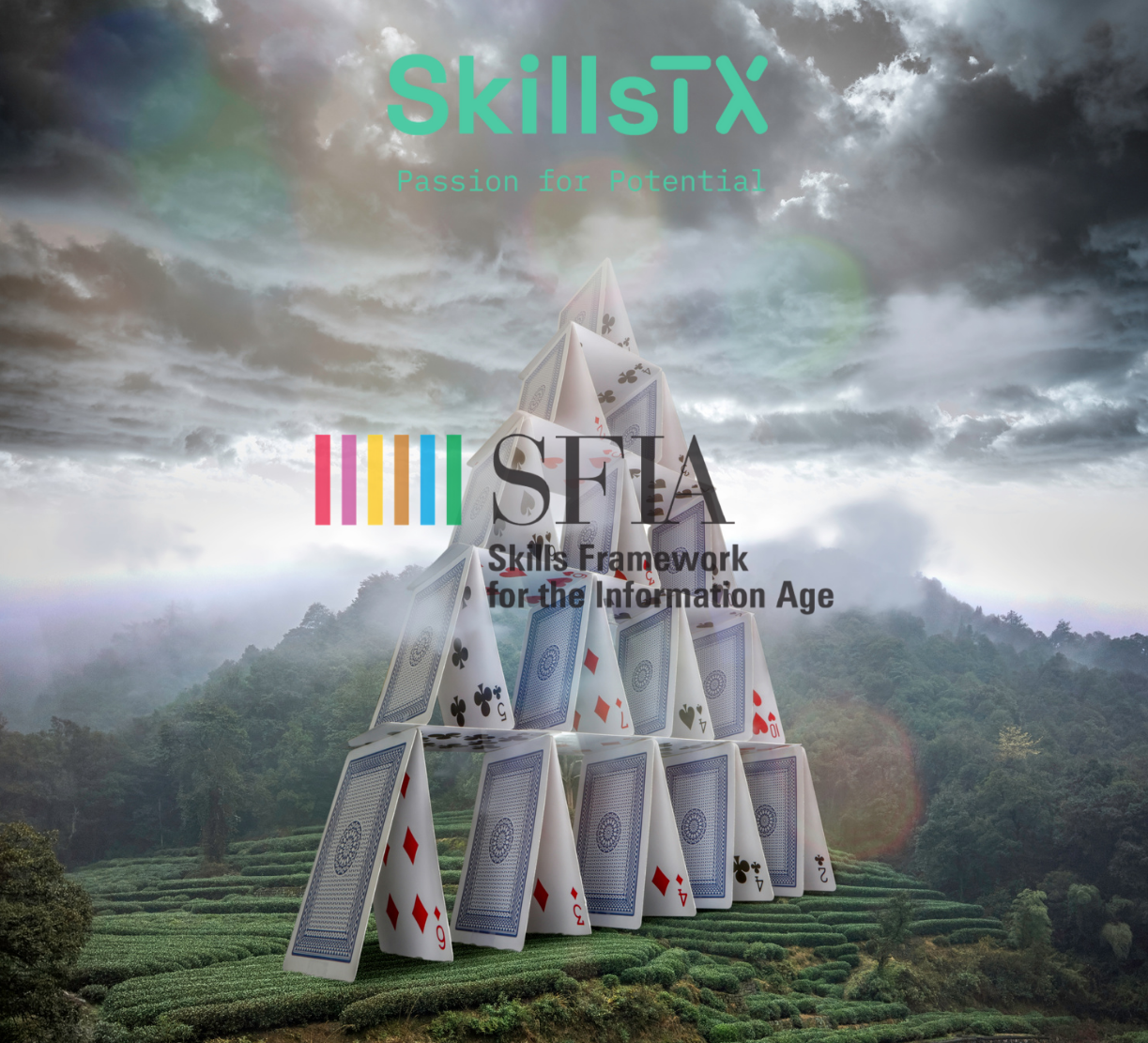
Picture this: a house of cards precariously stacked on a rickety table. That’s the traditional talent evaluation model. It’s all about diplomas, certificates, and the mythical “10 years of experience.” But guess what? That house of cards is collapsing.
Why?
Because it’s built on shaky ground—biased, exclusionary, and blind to true potential.
The House of Cards: A Fragile Foundation
Imagine that talent evaluation is a high-stakes poker game. The traditional model places its bets on three flimsy cards:
- Fancy College Degrees: These fancy scrolls are like playing cards with glittery designs. They dazzle at first glance, but do they tell us anything substantial? Sure, they indicate formal education, but they don’t reveal an individual’s ability to adapt, innovate, or collaborate. It’s like betting your life savings on a pair of twos.
- Expensive Vendor Certifications: Ah, certificates—the wild cards. They come in all shapes and sizes: project management, cybersecurity, underwater basket weaving (okay, maybe not the last one). But here’s the catch: not all certificates are created equal. Some are legit aces, while others are jokers in disguise. And guess what? The house of cards wobbles.
- The Mythical “10 Years of Experience”: Ah, the golden ticket—the elusive “10 years of experience.” It’s like claiming you’ve mastered chess because you’ve been moving pieces for a decade. But wait! What if those 10 years were spent playing checkers? Or worse, solitaire? Suddenly, the house trembles, and the wind whispers, “Impostor syndrome.”
The Shaky Ground: Bias and Exclusion
Now, let’s discuss the rickety table supporting this house of cards. It’s made of bias, exclusion, and outdated norms:
- Bias: The table legs are uneven, and bias is the culprit. Resumes with “ethnic” names get shuffled to the bottom. Gender stereotypes play peekaboo. Ageism creeps in like termites. The house leans dangerously, threatening to collapse under the weight of prejudice.
- Exclusion: The tablecloth hides a dark secret: exclusion. It’s a VIP club with a strict dress code. If you’re not wearing the right suit (read: prestigious university degree), sorry, no entry. Meanwhile, brilliant minds wait outside, knocking politely, but the bouncer (HR) is too busy checking LinkedIn connections for keywords.
- Blindness to True Potential: The flickering candle on the table illuminates only what’s familiar. It misses the diamonds in the rough—the self-taught coder, the artist-turned-data-analyst, the non-linear career path warriors. Their potential remains in the shadows, untapped.
The Solution: Skills-Based Talent Strategies
 But fear not! Here comes the hero—the skills-based talent strategy. It’s like a wrecking ball aimed at the unstable house of cards. Here’s why it’s unstoppable:
-
- Skills First: Instead of flimsy cards, we’re dealing with a deck of skills. Show us what you can build, analyze, or communicate. Your coding prowess, design finesse, and relationship management skills are the real aces. No bluffing allowed.
- Inclusive Table: The new table is round and welcoming to everyone. It doesn’t care if you learned from YouTube tutorials or Ivy League lectures—it’s all about what you bring to the feast. There are no velvet ropes, just open seats.
- True Potential Spotlight: The spotlight now shines on potential. The self-taught prodigy, the career switcher, and the autodidact are headliners. The house stands tall, built on solid ground.
SFIA: The Blueprint for Constructing Your Dream Home
Let’s explore how the Skills Framework for the Information Age (SFIA) from the SFIA Foundation can serve as the blueprint and common language for architecting the perfect “house of cards” regarding skills and talent management.

SFIA – A Blueprint for Skills Architecture
In construction, architects meticulously design blueprints before any physical structure takes shape.
Similarly, SFIA provides the digital equivalent—a blueprint for skills architecture. Here’s how it works:
SFIA – The Foundation of Your Structure:
Just as a building’s foundation determines its stability, SFIA establishes the foundational skills required for digital professionals. These skills span various domains, from technical expertise to interpersonal abilities.
SFIA’s seven skill levels act as the structural framework. Each level represents increasing complexity and proficiency. Professionals can assess their current skill level and plan their ascent.
SFIA’s levels of autonomy serve as essential pillars in establishing a solid foundation for structuring digital talent. These levels clearly delineate responsibility and authority.
Skill Mapping and Alignment:
Organizations can map their existing roles and responsibilities to SFIA’s skill categories. This alignment ensures that everyone speaks the same language.
Like an architect aligning beams and columns, HR and talent managers can identify skill gaps, create targeted learning paths, and optimize workforce planning.
Engineering Skills Excellence:
Engineers analyze the real world’s load-bearing capacities, stress points, and safety factors. SFIA applies similar principles to skills development:
Skill Elevation:
- SFIA encourages professionals to elevate their skills. It’s not about stacking cards but building a sturdy structure.
- Individuals can focus on specific skills, seek training, and demonstrate mastery. As they ascend the skill levels, they contribute to the organization’s overall strength.
Auditable Skills Inventory:
- Just as engineers maintain detailed records of materials and specifications, SFIA enables organizations to create auditable digital skills inventories.
- These inventories capture skills, certifications, and achievements. They empower professionals to showcase their expertise transparently.
By embracing SFIA, organizations can construct resilient teams, promote skills equality, and ensure everyone has a seat at the table.
A Blueprint for Skills-Based Talent Transformation: SkillsTX Talent eXperience
Imagine constructing a house of digital talent, innovation, and growth: each brick, beam, and intricate detail matters.
Foundation: SFIA as Our Architectural Guide
In the bustling city of Talentopolis, where organizations strive to build robust talent structures, we turn to SFIA. SFIA isn’t just a framework; it’s our architectural blueprint. Here’s how it lays the groundwork:
- Universal Language: SFIA provides a common language for skills assessment. It ensures clarity and alignment across teams, like an architect’s precise measurements.
- Collaborative Design: Practitioners worldwide contribute to SFIA’s evolution. It’s a living framework that adapts to industry shifts and technological advances.
- Neutral and Agile: SFIA isn’t tied to specific tools or vendors. It’s adaptable, like an architect who designs for diverse landscapes.
- Accessible to All: SFIA remains free for most non-commercial use, democratizing skills management.
Walls Rising: SkillsTX Talent eXperience Skills Intelligence Platform
Now, let’s raise our walls—the heart of our talent house—with SkillsTX Talent eXperience Skills Intelligence:
- Skills Inventory: Imagine an architect with a digital inventory of every brick, beam, and skill. SkillsTX captures your workforce’s skills and competencies, eliminating blind spots.
- Gap Analysis: Like an architect assessing structural weaknesses, SkillsTX proactively identifies skills gaps. Strengthen those pillars before they crumble.
- Agile Team Assembly: Whether building project teams or individual rooms, SkillsTX ensures optimal skill utilization. Tap into internal and external talent pools.
- Empowerment: Employees and managers shape their career blueprints. Skills profiles become the architectural plans for growth.
Evolving Canopy: Passion for Potential
Our vision doesn’t have a fixed roof—it’s an ever-evolving canopy, like the forest’s lush foliage.
Just as Mother Nature adapts to changing seasons, our talent ecosystem thrives on agility and resilience.
SkillsTX Talent eXperience Skills Intelligence breathes life into this dynamic vision, making it tangible for every inhabitant of our talent house.
The Time To Start Building is NOW!
Remember, the digital age waits for no one. Take the first step towards a future-proof workforce today.
Additional Resources:
- Request access to our on-demand demo showcase to see how SkillsTX Talent eXperience Skills Intelligence makes the SFIA Framework come to life.
- Ask yourself, “How well does my organization do Digital Skills Management?” | Take our 15-minute Digital Skills Management Maturity Assessment to find out. (40+ pages of tailored strategies for transitioning to a skills-based talent strategy)
- Download the FREE SFIA Cheat Sheet
- Create your own SFIA-aligned skills inventory by taking a FREE SFIA Assessment and compare your skills against more than 600 job descriptions and roles.
- Maximize your Microsoft Enterprise Services Agreement (ESA) with SkillsTX Talent eXperience, contributing to your Microsoft Azure Consumption Commitments (MACC).

 AUTHOR NOTE: Reproduced with thanks to John Kleist III, Chief Growth Officer for SkillsTX and author of Digital Talent Strategies, a popular newsletter on LinkedIn. John is a LinkedIn “Top Voice” and a Talent Management Revolutionary, Spearheading Skills-Based Digital Talent Strategies with SkillsTX Talent eXperience Skills Intelligence and the #SFIA Framework | Unlock Your #PassionForPotential.
#PassionForPotential #SFIA #SkillsFramework #SkillsIntelligence #WorkstyleTransformation #DigitalWorkforce #SkillsBasedTalent #FutureOfWork #MicrosoftAzure #DigitalTalent #DigitalSkillsGap #SFIA9BETA #GlobalStandards #CompetencyFramework
