
October 22, 2026
AI has exposed a weakness in how we think about skills and capability. When a human and a machine produce something together, knowing what each can do separately may still tell us surprisingly little about what they can accomplish together.
Not long ago, I was trying to solve a problem for Period Zero. I spend a considerable amount of my professional life talking about SFIA, the Skills Framework for the Information Age and the non-proft SFIA Foundation, because I believe in giving people a common language for capability. But SFIA is also exactly what it sounds like: a professional skills framework. I was looking for a way to make something extremely structured and academic more appealing for kids and young adults without taking away what makes it valuable.
That instinct did not come out of nowhere. Some of my favorite professional learning experiences were simulations that made complicated frameworks feel real. A hotel simulation helped ITIL click for me in a way another self-paced eLearning course never could. The Grab@Pizza simulation did something similar during my BRMP certification training. I had also seen some remarkable interactive education work over the years, including world-class experiences from Immersive Edge when we were kicking around SFIA ideas together. Those experiences have always stayed with me because they turned concepts into choices, consequences, tradeoffs, and something you actually had to work through.
So when I started thinking about how younger people might engage with SFIA, my instinct was not to explain the framework itself. It was to make it something they could experience. Somewhere in that problem, the idea for a SFIA-based game began to take shape.
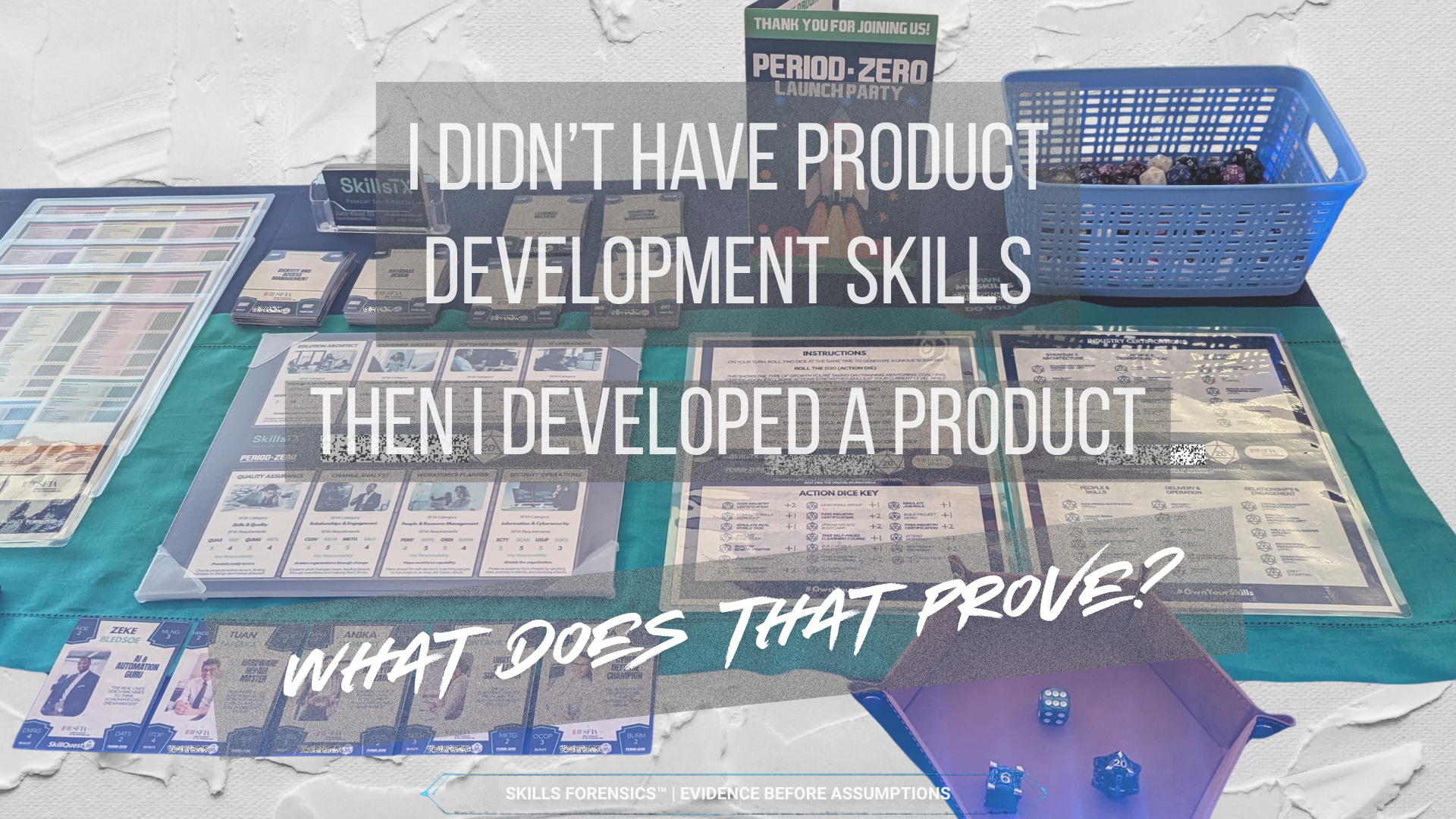
There was an obvious complication: I had never developed a product.
I had decades of experience across sales, technology, marketing, partnerships, strategy, and customer conversations. Product management, game design, UX, graphic design, and prototyping were not capabilities I would have confidently claimed. I also did not have a product team. What I had was a problem I cared about, an idea I could not leave alone, my Chasm Sherpa GPT assistant, Canva, and enough persistence to keep working until something that existed mostly in my head became something another person could actually experience.
Eventually, it did. The idea became a working prototype substantial enough to demonstrate publicly at the Period Zero launch last year.

It was the grand coming-out of an idea that had gone from proof of concept to prototype to product, even if other SkillsTX priorities later pushed further development onto the back burner.
Since then, my thinking has shifted toward assurance and what evidence is strong enough to support a capability claim. Over the coming weeks, I want to reconstruct this project using SFIA and a lot more rigor: what I contributed, what AI contributed, and where Kinko’s had to step in at the eleventh hour.
If I can reconstruct that honestly, we may learn a lot more than whether I “have product development skills.” I hope to understand what capability looks like when the work is produced by a system rather than a single person.
The Product Exists. The Explanation Is Harder.
It would be easy to say AI developed it. I do not buy that. AI did not decide that SFIA needed to become more interesting for younger people. It did not bring years of accumulated insight about capability, employers, learners, education, or the gap between how professionals describe work and how people actually experience it. It did not have the memory of learning through simulation and, years later, stopping to think that there was something powerful about that experience. It did not know when an idea technically worked, but it completely missed what I was trying to accomplish. Those judgments came from me.
But the opposite conclusion is just as weak. Building one prototype does not suddenly make me an experienced product developer. Put me in a mature product organization tomorrow, and there will be people who know things I simply do not. They have methods, instincts, failures, pattern recognition, and scars earned through years of doing the work.
So the prototype sits there like Exhibit A, refusing to cooperate with either easy explanation. “AI did it” removes too much of the human contribution. “John became a product developer” claims more than the evidence can support.
Maybe I demonstrated parts of the product development process. Maybe I demonstrated concept formation, creative direction, orchestration, judgment, iteration, or an ability to assemble capabilities I did not personally possess.
Maybe I demonstrated that I could translate a fuzzy idea into increasingly precise decisions until something usable emerged. Maybe some of the most important capabilities exist in the interaction between me and the machine rather than residing neatly inside either one.
I honestly do not know yet. That uncertainty is not something I want to clean up for the sake of a stronger headline. That’s why the question deserves serious investigation.
Even this article has become a small example of the same problem. I have repeatedly told the AI helping me write it that I cannot stand the one-line, staccato pattern that has infected so much machine-generated business content. I want developed paragraphs, tension, argument, and enough room for an idea to breathe. Yet the machine keeps drifting back toward dramatic sentences, unnecessary paragraph breaks, manufactured suspense, and another line acting like it deserves its own spotlight. I catch it, reject it, and redirect the work.
That is more than an editorial preference. It tells us something about contribution. The machine is extremely good at organizing ideas, generating language, consolidating information, and accelerating the writing process. I am the one who knows when the rhythm sounds synthetic, when the argument has drifted, when a metaphor is trying too hard, or when something polished still does not deserve my name on it.
That makes “Who wrote this article?” a much less useful question than it first appears.
If the work is produced by a system, measuring only the components can leave you exquisitely precise about something that does not explain the outcome.
Put the Same AI in Different Hands
Give two people the same AI model, the same information, the same assignment, and the same deadline. One understands the subject deeply. They challenge weak assumptions, recognize absent context, reject elegant nonsense, identify risk, and know enough to catch the machine when it is confidently wrong. When the work is finished, they can walk into a room, defend it, modify it, absorb contradictory evidence, and keep thinking when the document runs out. The other accepts the first answer that looks impressive.
Now imagine both finished artifacts look equally polished. The output may be similar, while the capability behind it is profoundly different.
This is where typical skills assessment starts to lose its footing. For decades, the individual has been the obvious unit of analysis: describe the work, identify the required skills, assess the person, find the gaps, and develop what is missing. Frameworks like SFIA bring discipline to that process by providing a common language for professional skills and levels of responsibility, rather than relying on job titles, résumés, or years-of-experience folklore. I am not arguing that we abandon any of that.
Does the individual remain the only meaningful unit of capability when they are no longer producing the work alone?
Consider someone who consistently produces exceptional analysis with AI. Give the same AI to another person, and the quality collapses. Clearly, the result was not explained by the model alone. Put the original person back, but remove the AI, and the thinking may remain strong while the speed falls, the range narrows, and some of what was previously possible disappears. The result was not explained by the human alone either.
The valuable performance emerged from the combination, yet much of our measurement instinct still wants to assess the human here and the machine there, and then assume we understand what happens when they work together. I am increasingly suspicious of that assumption because it feels a lot like measuring horsepower and driver reflexes separately, then pretending you have explained the race.
The uncomfortable possibility is that we are becoming better at measuring the parts while the work itself is being created somewhere between them.
The Artifact Can Be Real and Still Mislead You
AI slop has made this problem harder because we are surrounded by polished output with very little evidence of human depth behind it. Impeccable grammar, slick presentations, competent prose, and almost nothing memorable by the end. I understand why people have become suspicious of AI-assisted work. I hate the slop too.
What I do not accept is the leap from “AI helped create this” to “the human therefore contributed less value.”
I use AI extensively when I create. But I can walk into a room and talk through everything I publish. Challenge the argument, and I will challenge you back. Show me contradictory evidence, and I want to see it. Ask why an idea survived and I can articulate the reasoning. Ask why a paragraph disappeared, and there is a decent chance the machine produced something that looked perfectly respectable and sounded nothing like me.
Someone else can type “write me a disruptive article about AI and skills,” accept the first draft, and publish it. By keystroke count, AI may have contributed heavily in both cases. In terms of capability, the situations are nowhere close.
That is why a finished artifact can be completely genuine yet still provide weak evidence of the capability behind it. The software can run. The presentation can impress. The analysis can be correct. None of those facts automatically tells us who supplied the judgment, who understood the context, who recognized the risk, who could reconstruct the reasoning, or who would know what to do when the conditions changed.
This is exactly the kind of question I want to keep chasing as I explore what Skills Forensics™ might become. I have no interest in inventing a tidy score and pretending the problem has been solved. I want to understand what evidence can distinguish someone who can direct, interrogate, understand, defend, adapt, and reproduce AI-assisted work from someone who knows where the Generate button is. I want to know what survives when the model changes, whether capability transfers into another context, which decisions came from the human, which came from the machine, and which only became possible because they were working together.
But The Final Chapter Needed Another Human
The last obstacle was physical production. After weeks of working together, AI told me the files were ready to print. They were not. Kinko’s rejected them, and what followed was several more hours of me and the AI trying to repair something we had both believed was finished. Eventually, the person who got us across the line was Donna, a veteran print-production professional who understood things neither I nor the machine understood well enough.
That detail has become one of my favorite parts of the entire story because you cannot see Donna in the finished product.
Look at the game sitting on a table at the launch, and you would never know where AI performed brilliantly, where it failed, where I supplied judgment, where I lacked expertise, or where another human with a completely different capability had to step in and change the outcome. The artifact does not tell you any of that. It just sits there looking finished.
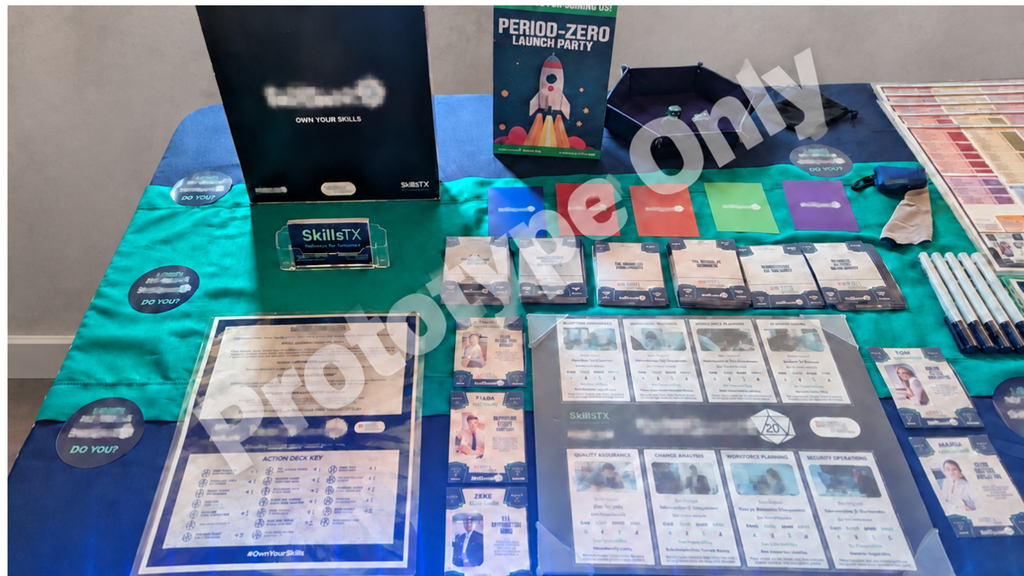
For years, workforce systems have tried to answer a sensible question: What can this person do? AI is forcing another onto the table: What can this person become capable of doing when paired with something that can do things they cannot? Donna makes me wonder whether even that question is too narrow.
I don’t claim that building one prototype made me a product developer. But I can put the product on the table, reconstruct how it got there, explain the decisions behind it, defend the thinking, show where AI expanded what I could do, and point to the exact moment when both of us needed somebody else.
The product is real. My contribution is real. The AI contribution is real. Donna’s contribution is real. What remains unresolved is which capabilities belonged to any one of us, which only emerged because we worked together, and what evidence would ever be sufficient to distinguish among them.
I’d like to present the case to you.
If someone produces an outcome with AI that they demonstrably could not have produced on their own, what capability do you believe they have actually demonstrated? What evidence would you need before you were willing to trust it?
The product is real. My contribution is real. The AI contribution is real. Donna’s contribution is real.
And if I ever get invited onstage to explain this whole mess, I may have to bring Donna with me. She could be the best evidence I have.
This article was originally authored by John Kleist III and is republished by SkillsTX with his permission; all original authorship, analysis, concepts, and commentary are credited to John Kleist III. Skills Forensics™ is a trademark of John Kleist III.
