
Gartner has reported that the requirements in a job description change by around 20% every year. Yet most workforce plans are still built on job titles, org charts, and headcount, often drawn from job descriptions that are four or more years old. As AI reshapes who does the work, and whether a human does it at all, that gap is getting harder to ignore.
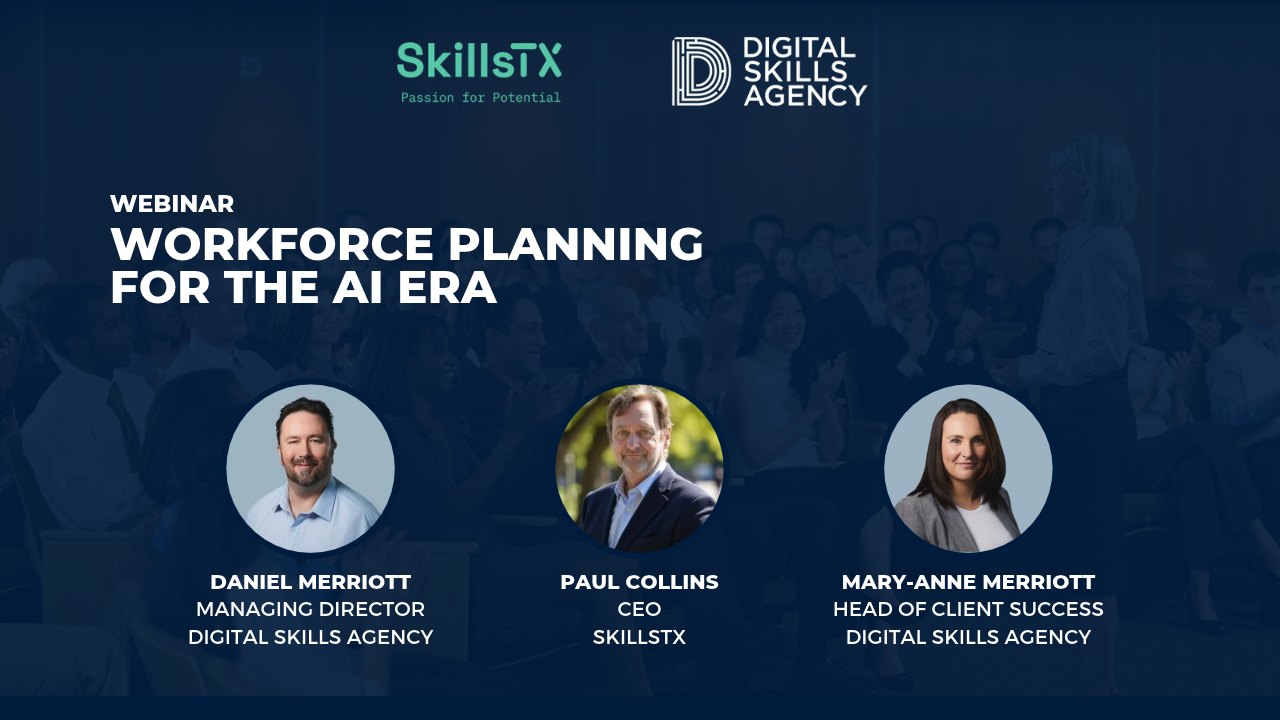
That was the starting point for our latest joint webinar with Digital Skills Agency. SkillsTX CEO Paul Collins and Digital Skills Agency Managing Director Daniel Merriott joined host Mary-Anne Merriott, Head of Client Success at Digital Skills Agency, to unpack why traditional workforce planning is falling behind, what leaders and HR teams are missing, and what needs to change.
Here’s a recap of the key themes from the session.
1. The job is the wrong building block
Mary-Anne opened by asking which workforce planning approaches have lost effectiveness over the last three to four years.
Daniel’s answer: many of them were never particularly effective. The same problems he saw five years ago persist today. Plans are poorly aligned to strategy, and little work goes into understanding the operating model and the capabilities needed to deliver it.
He pointed to a common symptom. Workforce plans are often presented as org charts, built on job titles and headcount. That approach lets planners skip the hard part, which is understanding what work actually happens.
“Workforce planning is about the work. It’s not about the jobs.”
Daniel Merriott, Digital Skills Agency
AI makes this more urgent. As people adopt AI tools, responsibility for specific tasks is shifting, and job descriptions rarely capture it. Daniel suggested assigning tasks to teams instead of individual jobs, which builds in flexibility and recognizes that some of the work may be done by AI. A job doesn’t disappear because AI handles part of it, but its nature changes.
Paul added that autonomous agents are now doing real work in some organizations, yet he’s seen org structures where a human’s name was simply swapped for an agent’s.
“I don’t think that’s gonna cut it. We need to be much more fluid than that when we’re planning.”
Paul Collins, SkillsTX
The result, in Paul’s words, is the wrong work being done in the wrong places by the wrong people. He also sees AI being adopted to boost productivity before anyone has asked what it should be used for and where it should be applied. Smaller organizations, with fewer industrial relations and policy constraints, are starting to treat their talent pool as a set of skills that can be directed to where the work is needed.
2. What leaders overestimate: prediction and assumption
Asked what leaders and HR teams overestimate, Daniel named the ability of a small group of people to accurately predict the future and design the workforce around it.
His suggestion: move away from multi-year plans that get constantly revised, leave space to make some decisions later, and invite the people closest to the work to contribute. If agile adoption has taught organizations anything, it’s that those people often know what they need.
Paul’s answer came from consultancy 101: never assume. A team of six business analysts gets planned as if all six can do the same work equally well. They can’t.
He also flagged accuracy. More organizations are using AI to populate skills systems by skimming job ads and job descriptions, then treating the output as the skills they have. Nobody checks whether those source documents reflected reality in the first place.
“Assumption is a bad thing, and data quality, as you would imagine for someone in our space, is something that we’re passionate about.”
Paul Collins, SkillsTX
The planning horizon has shrunk too. What used to be years away is now months, or as some people say, weeks. With the right data, organizations can move skills around and build the adaptability that a shorter horizon demands.
3. People and jobs are different things
When Mary-Anne asked which assumptions leaders need to let go of, Daniel put this one first: people and jobs are not the same thing.
Thousands of assessments show it. Most people are missing some of the skills their job asks for, assuming the job description is even current. Most people also have skills their current job doesn’t use. If planners can’t see those hidden skills, they leave capability on the table.
“We see organizations going out and hiring contractors for skills that actually they have in house, but they didn’t know.”
Daniel Merriott, Digital Skills Agency
Paul has seen organizations document workforce skills by asking each person for their job title, mapping the title’s skills onto them, and concluding that everyone is a perfect fit. That approach removes any clarity about where to invest in development.
He shared a client example. The organization was facing a potential layoff of around 70 people. Instead of working from job titles, it looked at the skills those people actually had. Transferable skills meant nearly everyone was redeployed into different areas and teams, and the business kept their domain knowledge in house.
4. Shared language and trustworthy data
Mary-Anne asked Daniel what an organization needs to start planning around skills, roles, and tasks.
The first requirement is a shared language. For digital skills, that’s where a framework like SFIA comes in, so everyone describes the same capability in the same way. Next comes making the data available. Leaders need to get comfortable reading it, and everyone needs to accept that skills gaps are normal. That acceptance depends on psychological safety, which Daniel called almost a prerequisite for exposing skills data.
Paul agreed that consistency of language comes first. Data points and tags scattered across systems mean nothing. SFIA describes the work well, but it doesn’t describe the technologies people use, so that layer needs to be part of the dataset too.
Good data will also surface uncomfortable truths. SkillsTX uses a supply and demand chart that Paul calls the “OMG chart,” because of the reaction when HR teams first see how much red is on it.
“But that’s a great thing, isn’t it? Now we’ve got something we can use to make decisions against.”
Paul Collins, SkillsTX
Daniel compared planning without capability data to writing a recipe for a meal you haven’t planned yet. A skills portfolio won’t remove uncertainty, but it gives you what you need to make that uncertainty manageable.
Paul outlined four decisions that good skills data supports:
- Develop: build on the skills you already have for what’s coming.
- Mobilize: move existing skills across the talent pool before reaching for a job ad, and backfill at a more junior level.
- Recruit: hire for specific skill gaps instead of a job title alone.
- Contract: bring in a transient workforce for the specific skills you can’t cover internally.
The same data can show today’s gaps and, projected forward, the different set of gaps your future plans will create.
How common is this kind of data? Daniel said most organizations have something, often a spreadsheet of what they call skills that turns out to be product knowledge, sometimes without proficiency ratings. Getting that data in front of the right people at every level, from team leads to department heads to executives, is extremely rare without good tools.
Paul warned about data that only looks reliable. A four-year-old skills register smells like data, so people assume it is. Many failed projects trace back to teams that believed they had the right skills because the data said so.
“We’ve got six people whose job title is DevOps engineer. Let’s be clear.”
Daniel Merriott, Digital Skills Agency
Paul noted that using SFIA at full granularity, the number of possible skill combinations for an individual exceeds the number of atoms in the visible universe. Six business analysts will always have six different profiles, and that matters when deciding who needs development.
5. From fixed jobs to capability-based planning
What does the shift look like in practice? For Daniel, it’s a fundamental change in how an organization plans. Start with the strategy, identify the capabilities needed to deliver it, and assess whether you have them. If you don’t, invest in building them and hand them into business as usual.
It sounds obvious, but many organizations write annual plans that assume the capability is already there. They’re then surprised by unbudgeted spending on contractors and third parties to deliver work they’ve never done before.
Paul described the mindset shift as deciding you want good data, the kind a checkbox exercise can’t produce, and accepting that it will challenge you. “Skills-based” is now a common phrase, and he’s seeing tangible signs that organizations mean it. That requires separating credentials from capability. A bachelor’s degree in project management is different from having run a project.
“This guy’s been a project manager for ten years. He must be a senior project manager. Show me the data.”
Daniel Merriott, Digital Skills Agency
Tenure is just as misleading. Ten years of small projects doesn’t qualify someone to lead your most critical ones. Paul added that strong technical skills don’t make someone a good leader either, yet promotion by tenure remains common.
He closed the section with another client example. The organization identified the skills it most needed to meet its objectives and decided to pay more for them. Employees who can prove those skills with evidence see it reflected directly in their pay, regardless of job title or grade.
Key takeaways
- Job descriptions change around 20% a year, yet many workforce plans rely on descriptions that are years out of date.
- Org charts and headcount skip the hard question of what work needs to be done. Planning should start with the work.
- AI is changing tasks within roles. Swapping a person’s name for an agent’s on an org chart misses how the work is shifting.
- People and jobs differ. Most people lack some skills their role asks for and have others it doesn’t use.
- Skills data scraped from job ads or inferred from titles creates false confidence. Data quality matters more than data volume.
- A shared language like SFIA, plus the psychological safety to expose gaps, makes skills data usable.
- Good skills data supports four decisions: develop, mobilize, recruit, and contract.
- Degrees and tenure are weak proxies for capability. Ask for evidence.
One thing to stop doing right now
We closed by asking both speakers for one thing a leadership team should stop doing if they want workforce planning to work again.
Paul’s answer: stop making assumptions. Take a big step back and ask whether what you’re using is based on assumption or on reality, meaning the data. Then be more critical about requiring evidence.
Daniel’s answer: stop headcount-based planning. It’s a comfortable answer to a hard question. Saying “we need this job title” avoids getting into the detail of the work, and real workforce planning depends on understanding that work.
Paul agreed, noting that people at a recent event kept asking him how big his team was. With AI used productively, a team of five can effectively do the work of 25 or 50, which makes headcount a misleading measure. Daniel added that networks count too. Associates and access to domain experts make any team more effective than its job titles suggest.
Watch on demand
Can’t watch right now? You can read the full transcript below.
Full transcript
Mary-Anne:
Welcome, everyone. Thanks for joining us today. We’re going to be talking about what happens when work itself is shifting under your feet. That is to say, how traditional workforce planning is not keeping pace with AI changes.
We’re going to cover, firstly, why workforce planning is failing in this environment. Secondly, what leaders and HR teams are missing. And finally, what needs to change to allow more effective approaches to come in.
My name is Mary-Anne. I’m Head of Client Success at the Digital Skills Agency, and I’ll be facilitating the discussion today between Daniel Merriott, who’s Managing Director at the Digital Skills Agency, and Paul Collins, who is the CEO of SkillsTX. I’ll be off camera most of the time so we can keep the focus on the discussion between Daniel and Paul.
So without further ado, let’s jump into things. To get started, a question for both of you. If a leadership team or an HR team right now was trying to update their workforce plan, what approaches do you think have lost effectiveness compared to what people were doing, say, three to four years ago?
Daniel:
I’m happy to start, if you like, Paul. I don’t think it was particularly effective three or four years ago, which I think is where I would start. The kinds of things we saw three, four, five years ago and we’re still seeing today are poor alignment to strategy, and little work actually being done to understand what the operating model is and the capabilities that are needed to deliver that strategy. You need those things to have truly effective workforce planning.
Paul:
Yeah, likewise, actually. Certainly those rigid structures, the reorgs that we see every year or two, that’s really not helping anyone these days. So I think it certainly needs a big step back and a big look at workforce planning in general.
One of the questions that I often ask right up front is, what do we actually mean by workforce, particularly in the world of AI and the rapid changes? It’s a good while ago, so I suspect this is an even scarier number now, but Gartner had reported that the requirements within a job description or position description change around 20% every year. And yet when you go and look at a job description that’s meant to define what’s required in the workforce, it’s got a date that’s four years old. So, yeah, we definitely need to pull our socks up.
Daniel:
Yeah, we definitely see that. And four years would be relatively recent for some organizations, that’s for sure.
The job description is a really interesting thing. I’m pretty sure it’s going to be something I keep coming back to in our discussion. I see workforce plans presented as org charts, and I think that’s an interesting but slightly shallow answer to the question of workforce planning. It relies on planning based on job titles and headcount, but it doesn’t require the people doing the planning to actually get down into the details of what work actually happens.
And that’s where I think workforce planning is about the work. It’s not about the jobs. Jobs are one way of modeling how you’re going to get the work done. You have to understand the work that needs to be done first, hence my earlier comment about the operating model.
Mary-Anne:
Let’s get into some more detail on that. I’m going to kick off the first question to you, Daniel. Why specifically do you think planning is failing, particularly with the rapid changes we’re seeing with AI? What part of these models is actually failing?
Daniel:
With regards to AI, I think it’s back to thinking about the job as the unit of planning. One of the things we’re finding now is that as people adopt AI, and as other changes go on, whether they’re AI-enabled or not, who is responsible for doing what work is starting to change, and often the job descriptions don’t represent that.
So one thing here is actually thinking about the work, maybe assigning tasks to teams instead of to the jobs within the team, which gives you a bit more flexibility, but also recognizing that it may not actually be a human doing the work. That doesn’t mean the whole job goes away. It might mean, as Paul said, that the nature of the job changes because an AI is able to do some of it, or make it easier for you to do some of it. So recognizing that we’re not just going to be changing jobs, we’re changing how we think about the work, is going to be the essence of it.
Mary-Anne:
Paul, do you have a view on that?
Paul:
I really concur with it. I’m just taking Daniel’s lead there and expanding it a little bit. When you’re looking at the units of work and these traditional job titles, I have to say I have some sympathy, because our world is based around “here’s a job, this is the remuneration, it’s based in this part of the country, so it’s got this loading on it,” or whatever it might be. So from that point of view, we are a little hamstrung and need to break out of that.
But it’s about seeing the work from the point of view that some work is more productive because AI is helping, and also recognizing that you’ve got some autonomous agents these days that are actually doing the work. I’ve still seen organizational structures where they’ve just taken a human’s name out and dropped in an agent’s name instead. And I don’t think that’s going to cut it. We need to be much more fluid than that when we’re planning.
Daniel:
It’s the wrong size building block, I think, is where we’re going to keep going back to.
Paul:
You bet.
Mary-Anne:
I’ve got a question for you, Paul. Where do you see organizations behaving like work is still stable, even though it clearly isn’t anymore?
Paul:
As I said, the structures, certainly in the public sector but also the larger private sector, are based around a salary package and remuneration. So there are those structures that we’ve got to work around. What’s starting to happen is the wrong work’s being done in the wrong places by the wrong people.
I’m also seeing a lot of use of AI because it’s designed to increase productivity, but the question hasn’t been asked in the first place: what do we want to use it to do, and where should it be applied?
Out in the market, there are some good signs that I’m seeing that it is becoming more fluid. Organizations are seeing the talent pool as a series of skills that can be directed to where the work is needed. Certainly in some of the smaller organizations that are able to do that with fewer issues around industrial relations, HR policies, and even unions, for that matter.
Mary-Anne:
Alright. Let’s talk some more about what leaders and HR teams are missing in all of this. A question for both of you: what do you think they’re overestimating in workforce planning in this kind of environment where things are changing? Daniel, do you want to kick off? I can see you smiling.
Daniel:
I was just thinking about Paul’s comment about the wrong work being done in the wrong place. I would probably say the first thing that gets overestimated is the ability of a very small set of people to accurately predict the future and therefore decide what the workforce needs to look like. Realistically, unless you’re in a vacuum, your ability to predict the future is somewhat limited.
So I think we need to get out of having multi-year plans that get updated on a frequent basis, and maybe actually leave some space to make decisions later in those plans. But also leave some space for those who are closest to the work to contribute towards that planning. One thing we’ve learned from all the trials and adoptions of agile practices across many organizations is that the people closest to the work often know what they need.
Paul:
Yeah. One of the things I’m picking up, and these two words spring to mind, is something I was taught back in consultancy 101: never assume. Assumption is a big problem for planning.
I’ll give you an example. We’ve got six business analysts, and the assumption is those six people can all do that work exactly the same, and that’s just not right.
And then the flip side of that is accuracy. We see lots of data, but it doesn’t necessarily reflect what’s actually out there in the workforce. I might have mentioned this on a previous session, but we’ve started using a term called “skill swap,” where we’re seeing all this data piled into these systems. And this is the worst bit: they’re using AI to capture it, and the reference points are wrong, because they’ll skim job adverts or job descriptions and say, “Right, those are the skills we’ve got.” Did you check the accuracy of the documents, and that those adverts genuinely reflect what’s needed?
So assumption is a bad thing, and data quality, as you would imagine for someone in our space, is something that we’re passionate about. If you’ve got those two things, you can do workforce planning, in whatever form that means to you.
But I’m back to what Daniel just said about the ability to look into the future. We used to talk about the horizon, and maybe that was a few years off. That’s just months off now, or as some people say, weeks. So, adaptability. If you’ve got the right data, you can move things around and get fluidity across your talent pool.
Mary-Anne:
Let’s talk about what people might need to unlearn to start helping themselves with this. Daniel, a question for you: what assumptions do you think leaders and HR teams need to let go of? Assumptions about jobs, job design, or capability? What do they need to let go of to make workforce planning work for them again?
Daniel:
I think the number one thing here is that people and jobs are not the same thing, and that’s demonstrably true. We know from thousands of assessments, and I’m sure most people know just from thinking about their own job and themselves, that you don’t have the same skills as what the job is asking for. So planning on the basis that the job is the same as the capability of the people is the wrong way to think about it.
Most people have some development needs, so they’re missing some of the skills the job might be asking for, and that’s assuming the job description’s up to date. But most people also have some skills that aren’t being asked for in their current job. And if you don’t know that, that’s a capability set you’re missing in your planning. We see organizations going out and hiring contractors for skills that they actually have in house, but they didn’t know.
Paul:
Exactly. I was just writing down, as you were talking there, Dan, almost your words. Don’t assume the jobs or the job descriptions describe what’s actually happening, and they certainly don’t describe the skills that a person with that job title has. So right up front, that’s a big mistake if you follow that. But sometimes that’s the path of least resistance.
I’ve actually seen organizations document the skills of the workforce by saying, “What’s your job? The job’s got these skills, therefore you have those skills,” which now means that every one of our people is perfect. In terms of being able to develop, you’ve got to have that clarity so you know where to put your time and effort.
I’ve got a wonderful anecdote from one of our clients. They were in a position where they could have been laying off about 70 people, so quite sizable. Then they had a look at the skills people actually had, rather than just the job title. The job title had gone, and I think they pretty much redeployed everybody, because there were transferable skills that worked in a different area and a different team. Those people have kept the domain knowledge inside that business, and domain knowledge is another thing that has currency. So that’s another aspect of making the best use of the skills you’ve got.
Mary-Anne:
Right. Daniel, feeding off what you were talking about earlier about breaking workforce planning away from the concept of jobs only, something we’ve heard you talk about before is the concept of skills versus roles versus tasks. I’d really like to hear you riff on that a little more. What do you think an organization needs to do to start using a model like that?
Daniel:
Probably the number one thing is to actually have a model, a shared language. This is where frameworks like SFIA come in when you’re talking about digital skills and capability and the work that needs to get done in that domain. It’s having a shared way of communicating about the same thing, so we’re not talking apples and pears. We’re all talking about the same thing, meaning the same thing. That’s probably the first place I’d go.
Then making that data available is going to be the next thing. We need to get comfortable with what that data is going to show. Leaders need to get comfortable with understanding it. But we all need to get comfortable with the idea that we have skills gaps. That’s normal. Most people have some development needs in their job. But that also requires some psychological safety. It’s almost a prerequisite for exposing that data.
Mary-Anne:
Let’s talk about visibility of data. Paul, I’d love to hear from you from that perspective. What do you think organizations are missing that stops them applying new workforce planning models effectively?
Paul:
I’m going to pick up on things that we’ve discussed previously, not necessarily in this session. Consistency of language is where we need to start. If you’re just throwing data points and tags all over the place, it means nothing, and we’re off chasing shadows. So we need consistency of language.
Frameworks do an amazing job at that, but they need to be applicable to the domain they’re being applied to. We obviously use SFIA. That’s a wonderful, consistent language to describe what actually happens, the sort of work, but it doesn’t describe the technology you use. So that piece has got to come in as well, as part of the dataset, to give you that richness.
And then the other aspect, which again I’ve discussed with Daniel, is that we’ve got to recognize the data is going to present some challenges. It’s going to show gaps. Down at an individual level, you might not have the same skills as the person next to you. You might be better, you might be worse, but that’s not a problem. It’s just highlighting an area we can now focus on, so you can spend your time wisely, and maybe your money wisely, in terms of development.
So that’s it really from a data point of view: consistency, but also recognizing that data isn’t always going to tell you the story you want to hear. And in a leadership scenario, that travels right up the chain to the people doing the workforce planning. We have a chart that we use, which is a sort of supply and demand chart. I call it the OMG chart, because normally when someone in HR or workforce planning sees it for the first time and there’s a lot of red on it, it’s like, “Oh, wow.” But that’s a great thing, isn’t it? Now we’ve got something we can use to make decisions against.
Daniel:
I think it’s a fair point, Paul. If you want people to be able to plan for capability, they need to see capability-related data. When you actually have a skills portfolio that shows what you’ve got, it doesn’t remove the uncertainty, and it doesn’t solve all the problems. It just means you now have the data you need to create a plan to make that manageable. Without that, you’re really trying to write a recipe for a meal you’ve not yet planned.
Paul:
I like it, actually. Just adding a little more granularity to that. I’m not saying this is the be-all and end-all of workforce planning, but we see four key decision points that come from the data.
The first one is, where do we need to develop skills? That’s making use of what you have and building on it for whatever you’re looking at on the horizon, however far away that is these days.
Then, of course, the ability to mobilize skills within your talent pool. Before you go reaching for the job advert, have a look. You may already have skills that can deliver what you need, and you just move them around and maybe backfill, bringing people in at a more junior level.
And then the final two, and I’m sure there are more. We can use the same data to help us recruit. We have these gaps, and we want people with those skills. There’s a job title attached to it, but it’s the skills that are actually the key. And then finally, the sort of backstop, where you’re bringing in a transient workforce or contractors, whatever you want to call them, again bringing in the specific skills you need for what you’re trying to achieve as an organization.
The final piece is recognizing that, from a data point of view, the gaps will certainly highlight what you’re missing right now against what you’re trying to achieve today. It’s unlikely that anyone’s got the perfect workforce with everything covered. That just isn’t the way the world operates. But you’ve also got to be able to take that same data and project it to what you’re planning to do in the future, and that will be a different series of gaps. It’s usually more, but not always. You might just have got lucky and have a workforce that happens to be quite well aligned with the way the world’s moving.
Mary-Anne:
How common do you think it is for organizations to actually have access to this kind of data in the first place? How many people actually start from a database when they do workforce planning at all?
Paul:
I’ll let you take that one, Daniel.
Daniel:
To be fair, I think this is a problem lots of people are trying to solve. We come across organizations that have a spreadsheet of what they’re calling skills. Often it’s actually product knowledge, and even then it may not have a rating of your level of knowledge. Or they’ve tried to put another framework in place and done some kind of assessment.
So I think there’s usually some data. But whether it’s available to the people who need it, and whether it’s used to inform both individual staff development and team-wide, department-wide, or even organization-wide development themes, that’s extremely rare. Actually getting the data out and putting it in front of people at different levels, the team leader and their staff member, then the department head or the organization leader, and using that data to inform decisions at the level that’s appropriate to them, is extremely rare without good tools.
Paul:
I’ll just pick up on that as well, Daniel. It’s a dilemma. There’s having no data at all, so you’ve got to go and uncover it, compared to “Yes, we’ve got a skills register, and here’s the spreadsheet from four years ago,” and the assumption that you have the data because it looks like data. It smells like data. It must be data.
And then the real big question is, how reliable is it? Has it got some veracity? Because the worst thing I see is decisions being made on it. Let’s be honest, we see projects fail left, right, and center. And when you scratch into them, quite often it’s because they set off without knowing whether they had the right skills across the resource pool, or they thought they did because the data said so. “We need six DevOps engineers. We’ve got them.” But at what level are they operating? Are they using the right technologies?
Daniel:
We’ve got six people whose job title is DevOps engineer. Let’s be clear.
Paul:
That’s exactly it. In fact, that’s a much more precise way of saying it. I’m not going to put money on it, because I’m not a gambler, but I guarantee that however many DevOps engineers you’ve got, they’ve all got different levels of skills, and they’ll all have their own profile against that expectation.
If you use SFIA the way that we use it, just that one framework, based on that granularity, here’s a number I love quoting: the number of combinations of skills for an individual is more than the number of atoms in the visible universe. That’s how precise you can get. So it’s pretty easy to say, “Well, you’ve got six business analysts,” but I can guarantee they’ve all got slightly different skills at different levels. And that’s important, especially when you’re making decisions about what you need to develop. Some people don’t need it. Other people do, regardless of the job type.
Mary-Anne:
Alright. Let’s change tack a little and talk about what needs to happen for people to access more effective approaches. A question for both of you: what do you think it means in practice to start shifting from planning jobs on a fixed basis to planning on a capability basis?
Daniel:
For me, it’s a fundamental change in how you plan for the organization. If you take a generic model for translating strategy into delivery, it would be: what’s our strategy to achieve our organizational goals, what are the capabilities we need to deliver on that strategy, and then an assessment of whether we have those capabilities. If we don’t, we spin up the programs and make an investment decision to build those capabilities, then hand them into BAU. Or if you do have them, then obviously you task that in BAU.
That sounds really obvious, but I’ve definitely come across quite a few organizations that have annual plans that assume they have the capabilities they need. And then they’re surprised to find they’re spending money they hadn’t budgeted for on contractors and third parties to help them deliver things they don’t currently have the capability for and have never been asked to do before.
Paul:
Yeah. I’m almost reading the list on the banner behind you there; it sort of says it all. The mindset shift is, first of all, making a decision that you truly want good data, and not just data from a checkbox exercise, and recognizing that the data is going to present some challenges.
In terms of that paradigm shift, the great news is that more and more we hear this term “skills-based.” It’s thrown around all over the place, and it’s finding its way into education now, but I’m actually starting to see tangible signs that it’s being taken at face value.
When we talk about skills-based, back to the data again, another mindset shift is moving away from “we must have the skills because this person’s got a bachelor’s degree in project management.” Yes, but have they ever run a project? That’s a big difference. For sure, you won’t get a degree without some hands-on experience. But that’s a bit different to actually running a project wherever you are in whatever workforce. And that’s what skills-based means to us. That skills assessment piece behind you there, Daniel: what have you really got?
Daniel:
I think equally dangerous, Paul, would be “This guy’s been a project manager for ten years. He must be a senior project manager.” Show me the data. Let’s see some evidence of that. That could be someone who’s run a long series of small projects over a long period of time and is very comfortable, maybe doing a great job at that scale, but it doesn’t necessarily make them a senior project manager you’d want to give your most critical projects to. So even length of service is not a good indication that they have the right skills.
Paul:
And that leads on to the sort of catch-all that just because you’re a good technology person doesn’t mean you’re a good leader or manager, because that’s a different skill set. It’s not to do with tenure. But unfortunately, that’s how workforce planning often works: you’ve been here the longest, so you get the senior role. There are better ways of rewarding people if you’ve got good data.
I’ll give you another little anecdote as a snippet. Another client did some analysis up front: what are the skills we really, really need to meet our objectives? And they decided to pay more for those skills. So if an employee comes along and proves with evidence that they’re good at what the organization needs, that directly reflects in their take-home pay at the end of the month. That’s a pretty brave thing to do, and it’s all data-related, not based on job title or grade. I think that’s a pretty good indication that we are seeing a slow shift to skills-based planning.
Mary-Anne:
Let’s close things off with a final question for each of you. What would you say is one thing a leadership team should stop doing right now if they want their workforce planning to become more effective again? Paul, let’s start with you.
Paul:
I’d stop making assumptions. I’m just going to bring it back to that really simple premise. I could go a lot deeper than that, but let’s keep it simple. If you want to take something away, take a big step back and ask yourself, is what I’m using assumption-based, or is it actually based on reality? And by that, I’m really referring to the data, of course. The only other thing I’d throw in is that it’s not so much about what you stop doing, but also being a bit more critical about requiring evidence.
Daniel:
I think if there’s one assumption I’d really want to put on the table, and I’m not going to say job descriptions again, it’s headcount-based planning. It’s a very comfortable answer to a hard question, which is, what work do we need done? It’s saying “we need this job title,” so it doesn’t require getting into the detail of the work. But if you truly want workforce planning, you do need an understanding of the work.
Paul:
That’s a really good point. You look at the org chart, and the headcount’s there. A little anecdote from my point of view: I was at an event the other week, and everyone kept asking me what size the team is. And I said, tongue in cheek, “Well, what does that matter, really? It’s the work we do.” And it’s a bit of a moot question these days, because if I’ve got a team of five and they’re all using AI in a productive way, I’ve effectively got a team of 25, or even 50. So headcount is very misleading. It’s the work that gets done that matters.
Daniel:
Part of that’s network, too. One of the things we’d say is there’s an associate network around us as well, with access to domain experts across multiple domains. All of that makes your team and mine more effective than it would be if you just looked narrowly at what’s my job title and what’s your job title.
Mary-Anne:
Well, thanks, both of you. That brings today’s discussion to a close. And to our viewers, if you have challenges with these sorts of questions in your own organization, do send us your questions. We’d love to have them and use them to build our future sessions. Thanks again, Daniel, and thanks again, Paul. It’s been a really insightful discussion, and thank you to our viewers for joining us. We look forward to seeing you again at our next session.
About SkillsTX and Digital Skills Agency
This webinar is part of an ongoing series from SkillsTX and Digital Skills Agency on workforce capability.
SkillsTX is a skills intelligence platform built around the SFIA framework, helping organizations understand, measure, and build their digital workforce capability.
Digital Skills Agency works with organizations on workforce planning, capability development, and the people side of technology change.
Learn more about SkillsTX →
Learn more about Digital Skills Agency →
