September 17, 2026
Consider this: your workforce capability dashboard flashes red for cloud security, AI governance, data engineering, or stakeholder leadership. The usual response? Train, hire, reshuffle, buy talent.
But before that, there’s a more important question:
What exactly did we PROVE is missing?
Did we prove the capability is actually absent? Or did we just fail to find evidence that’s there?
These are radically different conclusions. But that distinction vanishes quickly when incomplete info becomes a gap score, a heat map, and then a board-level decision.
An empty field can mean a dozen things: no assessment, old evidence, confidential work, capability in another system, undocumented by a manager, changing requirements, or weak assessment.
Or yes, maybe the capability really is missing. Uncertainty is not the problem.
Pretending all those situations mean the same thing; that’s the problem.
That is why I think the old “skills gap” conversation is running out of road.
When I entered this world in 2021, closing skills gaps was everywhere: find the gaps, close the gaps, upskill, reskill, repeat. That language was useful.
But the questions organizations are facing now are bigger. They are increasingly about assurance, risk, resilience, and agility, and about whether an organization can actually prove it possesses the capabilities its AI strategy depends on.
- Can you prove your transformation team can execute?
- That critical capability survives when key people leave?
- That a supplier can deliver what it sold?
- That a credential means what you think it means?
- That your people can operate alongside AI? That the AI itself can actually do what the vendor claims?
Those are enterprise questions. And answering them credibly requires something workforce technology has historically struggled with:
scientific rigor.
Not another impressive dashboard. Not some proprietary score attached to a model. Not five systems echoing the same original assertion and calling it corroboration.
Scientific rigor means being disciplined about what we know, what we infer, the evidence we actually have, and what remains uncertain before we can defend a conclusion.
Evidence and Rigor
Skills Forensics™ did not invent any of that. Auditing, intelligence analysis, and statistics have wrestled with evidence, uncertainty, and false conclusions for decades. Failing to detect something is not the same as proving it’s absent.
I am much more interested in borrowing rigor from mature disciplines than inventing jargon for things smarter people already understand.
What fascinates me is what happens when we apply that rigor to capability.
There’s a major difference between a verified capability deficit and an evidence gap.
A verified deficit isn’t just a blank profile, old credential, weak inference, or missing documentation. It means there’s a defensible requirement and strong evidence that someone or a system didn’t meet it under real-world conditions.
An evidence gap is different. Sometimes the requirement is valid, but the evidence can’t confirm or refute the capability.
The honest, scientific answer isn’t “incapable.”
It is: We don’t know yet.
That may be inconvenient, but it’s valuable, and it changes what happens next.
If you have a verified deficit, development, hiring, reassignment, or automation may be justified.
If you have an evidence gap, investigate: observe the work, ask for stronger evidence, run a work sample, validate contribution, look for independent corroboration.
Don’t spend money solving a problem you haven’t proven exists.
If the requirement is vague, stale, or disconnected from strategy, assessment won’t save you. You’re measuring against the wrong target.
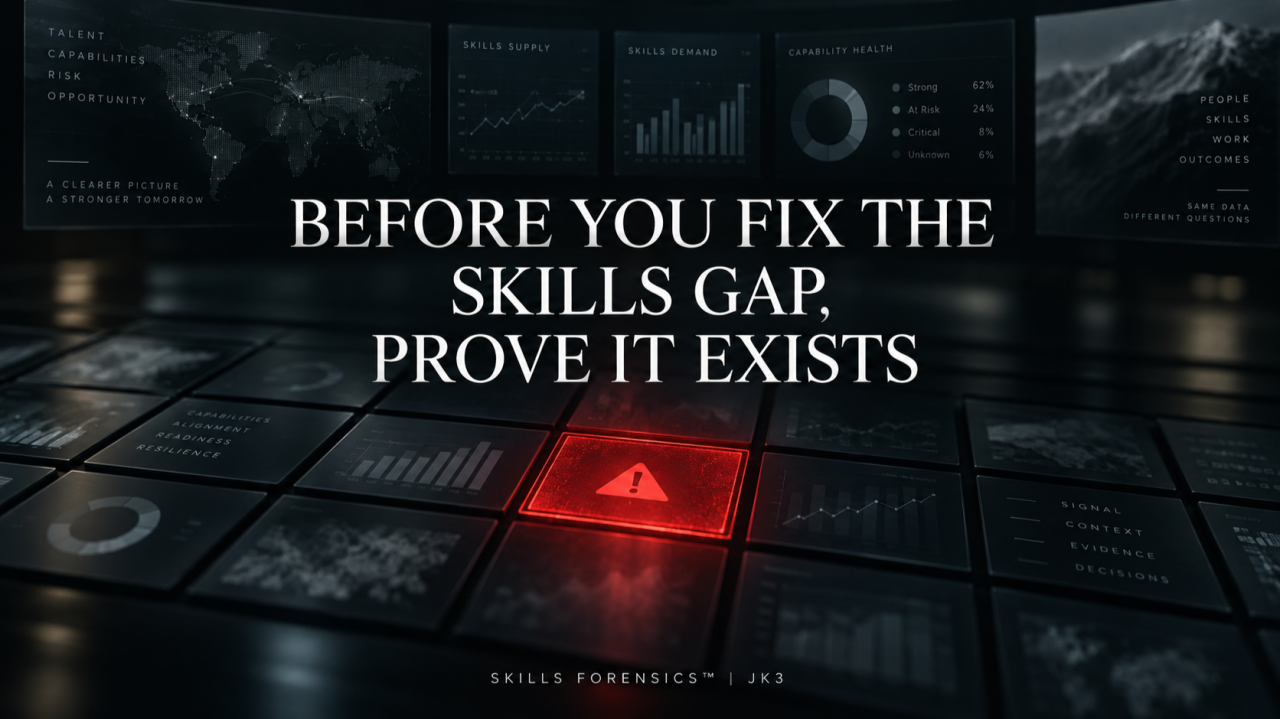
The same red box on a dashboard could mean three very different realities:
A real capability deficit. Insufficient evidence. A defective requirement.
One red box, three truths, three decisions.

That should matter in the boardroom. It is also why I am increasingly skeptical when people describe a workforce system as a “single source of truth.”
A system can tell you what has been recorded. That doesn’t automatically tell you what’s true.
The same goes for credentials. A credential can be authentic and current but still not prove someone can do the work you need. Someone without the credential may have the capability. Someone with it may have demonstrated something real, but not necessarily in your context or to your standard.
Unknown does not mean incapable. Verified does not mean universal. That distinction matters.
AI Changes the Stakes
AI is going to make it matter even more.
We’re moving quickly from asking what humans can do to what models, agents, and human-AI systems can do. An AI agent that performs well on a public benchmark isn’t automatically proven capable of doing your organization’s work with your data, your constraints, and your oversight.
Again, scientific rigor matters.
What exactly was tested? Under what conditions? Against what requirement? How repeatable was the result? What evidence supports the claim? What remains uncertain?
These questions aren’t anti-AI; they are quite the opposite. I’m optimistic about what AI can help humanity accomplish. But disruption will punish organizations that confuse capability claims with hard evidence.
Whether it’s a person, a supplier, an AI, or any combination, the challenge is brutally simple:
What value do you contribute? What evidence would allow someone to defend that conclusion?
That is where Skills Forensics™ keeps taking me.
Not toward another skills database. Not toward another assessment dressed up with a better interface. Not toward a confidence score invented before anyone has scientifically validated what the number actually means.
The research keeps pushing me toward a harder question:
What if capability systems were designed so “not demonstrated” could never quietly become “cannot do”?
That would require disciplined requirements, evidence that fits the question, transparent uncertainty, attention to context and recency, genuine corroboration, and decision rules that survive challenge.
That is still a hypothesis. Because if this idea is going to matter, scientific rigor can’t be just a marketing phrase. It has to become the standard the idea itself must survive.
As boards and executive teams build their 2027 strategies, I would put one question on the agenda before approving another workforce transformation, reskilling initiative, AI investment, supplier decision, or talent strategy:
When the dashboard screams “GAP,” can you truly prove the capability is absent; or have you just discovered the limits of your evidence?
Once you see that distinction, it’s hard to unsee.
