
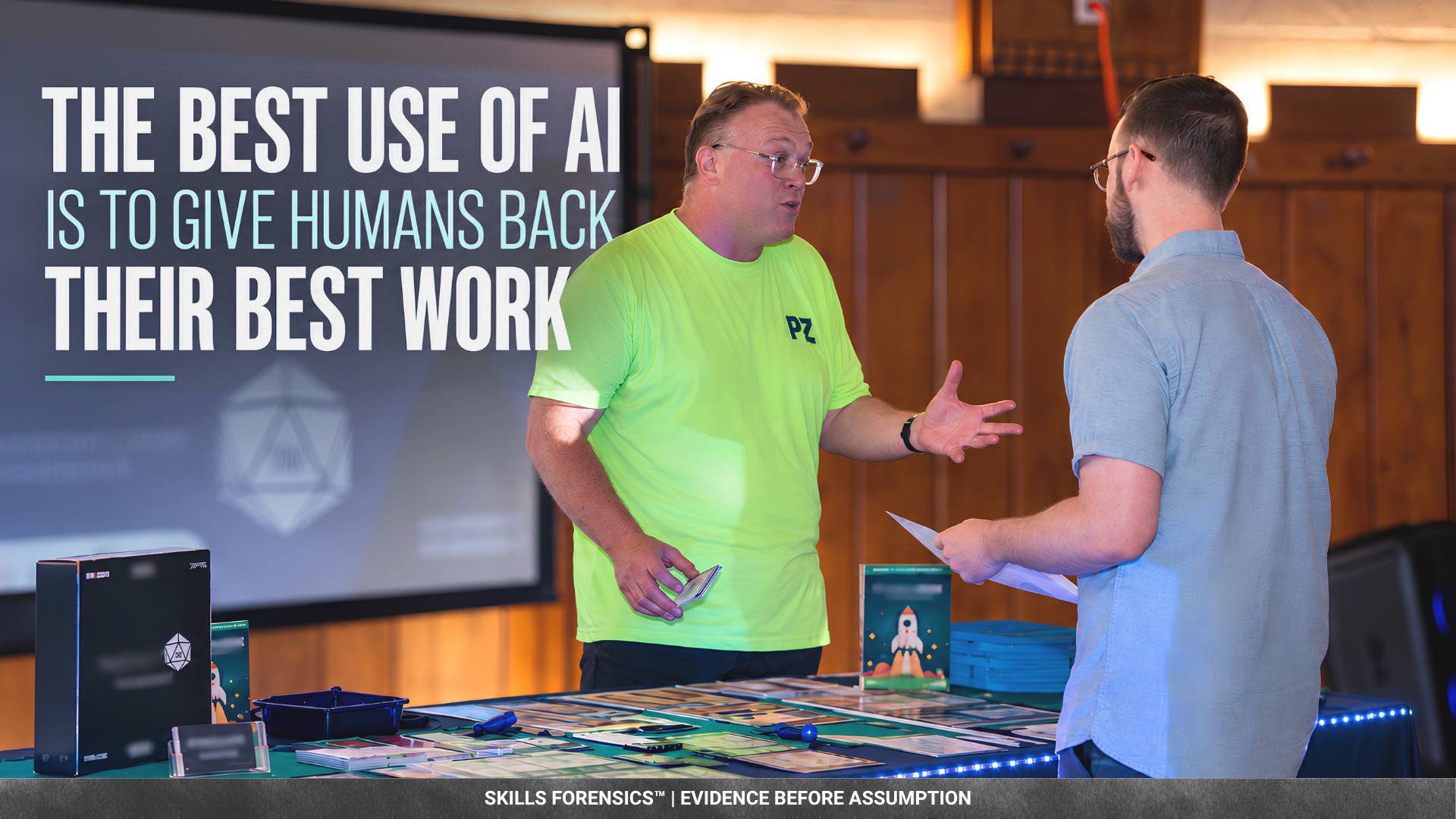
October 8, 2026
We keep talking about AI as a productivity engine, a threat, a shortcut, a cheating machine, or a way to replace humans in the workforce. I think we are missing the much bigger opportunity:
using AI to give people back the hours they have been wasting on work that barely uses what they are actually great at.
Sometime last year, AI stopped feeling like a tool I occasionally used and started feeling like part of the way I actually work. I was building a prototype for a SFIA (Skills Framework for the Information Age)-based game concept, and I did not have a product team around me: no developers, product managers, designers, researchers, marketers, or creative agency. I had myself, an AI partner I had spent a long time shaping around the way I think, and a Canva subscription. Somehow, that combination allowed me to do work that normally would have been distributed across a small team, and the prototype became real enough that I eventually demonstrated it publicly at the Period Zero launch party.
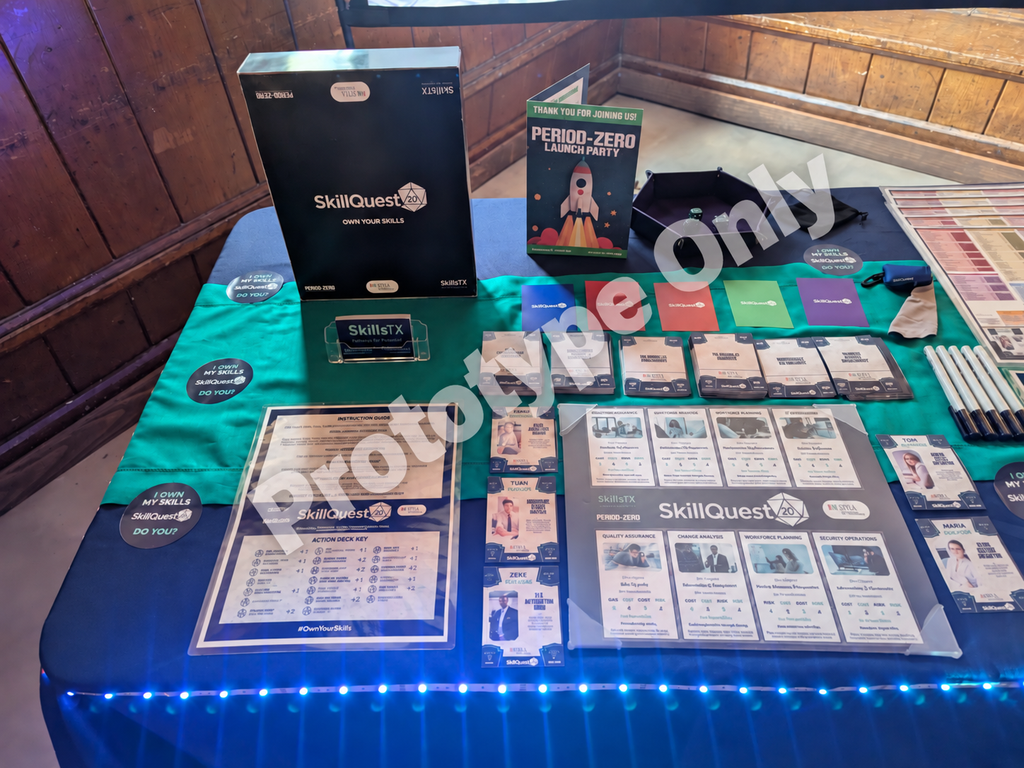
We have not developed it further. Yet. But the experience changed the way I think about capability because I did not suddenly become all of those professionals. I did not wake up one morning with years of product-development expertise downloaded into my brain. At the same time, it would be ridiculous to say I had learned nothing or contributed nothing simply because AI helped me execute. Something new happened in the combination, and I have been trying to understand what that means ever since.
AI is now woven into almost everything I do. I use it to research, analyze, prepare for meetings, pressure-test ideas, write, strategize, organize things rattling around in my head, and sometimes challenge me when I am falling in love with my own bullshit. I tell people all the time that I am a much better AI-augmented human being. The outputs I have produced personally and professionally over the last couple of years are eons beyond what I was producing before I started working this way.
But the biggest change is not that I can do more work. It is that I can spend more of my life doing the work I am actually good at.
I Have Already Lost Enough Life to Work a Machine Can Do Better
For years, serious research into prospective customers or partners could take up half my day. I would read annual reports, company news, 10-Ks, leadership biographies, and everything else I could find while mapping an account, understanding priorities, and developing a strategy. I was good at it, and it mattered, but it was also hours of reading and synthesis before I ever spoke to another human being. Sometimes all of that effort still did not result in a meeting.
AI can now compress a massive amount of that work. Research still matters, but I spend far less time plowing through the mechanics and far more time on what creates the real commercial value: talking with people, understanding them, building trust, connecting ideas, creating energy, and turning an account into an actual relationship. Looking back, some of those hours feel like life I will never get back.
That is the AI conversation I wish more executives were having. Instead, we keep asking how many more emails someone can write, how much faster a report can be completed, or how many additional tasks one employee can absorb. That is an industrial-age definition of productivity wearing an AI hoodie.
AI’s greatest value is not helping people do more. It is giving people back the time to do what only they can do best.
I have had a personal mantra for years: take what you do and do it best, and pay somebody else to do the rest. Obviously, that philosophy gets easier when you have the money to build the right team around yourself. AI changes the economics dramatically. Increasingly, “somebody else” can be an agent or a model that handles work that never deserved the best hours of your day in the first place.
Done well, that does not make the human less important. It makes the human contribution more important because the person can spend more time on the things technology cannot commoditize as easily. Give me back ten hours this week, and I do not want ten more hours of administrative work. I want ten more hours for ideas, relationships, strategy, conversations, and the parts of my work where I can actually move something.
That should be a workforce KPI: not “How much more output did AI squeeze from John?” but “How much more of John’s highest-value capability did AI make available?”
The Same AI in Different Hands Is Not the Same Capability
This is also why I am increasingly uncomfortable with the way we talk about “AI-generated” work.
Take this article. I could ask an AI system to write 1,200 words about human-machine collaboration and walk away. It would produce something readable in seconds. It would be grammatically strong, professionally organized, and full of the same predictable language that makes so much AI-generated business content disappear into our feeds without leaving a mark.
I do not use AI that way. I argue with it. I reject things. I change the premise. I tell it when the language sounds nothing like me. I drag it away from the one-line rhythms and fake profundity it continually wants to produce. I inject 30 years of sales, marketing, technology, partnerships, mistakes, customer conversations, and professional scar tissue into the process.
AI can generate endless words. My contribution is often knowing which ones are bullshit.
That distinction is becoming enormously important because output volume tells us almost nothing about value contribution. If a model writes 80 percent of a document but the human recognizes that the central argument is wrong, introduces the decisive context, rejects a dangerous recommendation, and determines what ultimately goes to the customer, did the AI contribute 80 percent of the capability?
By keystroke count. By consequence? Not even close.
The same AI in different hands is not the same capability. What the human brings may be exactly what makes the combination extraordinary.
This is one of the places Skills Forensics™ keeps pulling my thinking. If a human and AI produce something together, what does the finished work actually allow us to say about either one’s capability?
The artifact alone may not answer that. A brilliant market strategy could mean the human is an exceptional strategist who used AI to accelerate research. It could mean the model found an insight that a human would never have discovered on their own. It could mean the human supplied the judgment that turned average AI output into something commercially valuable. Or it could mean someone pasted the assignment into a model and accepted the first response.
Those scenarios may produce similar-looking documents. They do not represent the same capability.
That suggests our old statement, “John has strategic planning skills,” may eventually be far too crude. A more meaningful question is whether John can reliably produce a particular strategic outcome, under defined conditions, using the tools and assistance that are actually part of his working environment.
The capability may belong primarily to the human. It may belong primarily to the machine. It may become valuable only in combination.
If the business decision depends on that capability being real, we should probably know the difference.
The Calculator Was Cheating Too
I understand the discomfort. People have strong feelings about what someone should be able to do “on their own.” Academics will wrestle with what constitutes original work. Employers will debate disclosure. Creators will worry about authorship. Entire professions will defend capabilities that technology is making less scarce.
But I remember when using a calculator was cheating. Mic drop.
Humans have always built tools that let us stop doing things the hard way. The more important question is what we do with the capability that gets released.
I have fantasized about this since I was a kid. My ADD brain was never going to happily sit down and read every classic novel, every great work of philosophy, and every meaningful piece of literature I wished I had absorbed. I used to imagine how incredible it would be if somebody could plug a chip into my brain and simply give me all of that knowledge.
I still cannot plug in the chip. But damn, we are getting close.
I can now interact with systems that help me access, compare, and explore an extraordinary amount of human knowledge in seconds. That does not magically make me Shakespeare, Einstein, or a historian. It changes what I can reach, what questions I can ask, and what ideas I can connect.
So I am genuinely torn when people ask whether somebody deserves the same credit for producing an extraordinary outcome with AI as someone who could produce it entirely unaided.
Part of me understands the argument that the underlying individual competence matters. Another part of me comes from sales, where the customer mostly cares whether the damn thing works.
Both matter. That is exactly why we need more scientific rigor, not less.
Take the same meaningful piece of work. Have the human do it alone. Have the AI do it alone. Then have them do it together. Change the model. Change the human. Change the context. Repeat the task. See what survives and what disappears. Now we are actually learning.
One impressive artifact proves that something worked once. Reliable capability is a much harder claim to make.
Human + AI Is Becoming an Assurance Problem
There is a less inspiring side to all of this that organizations cannot afford to ignore. Since COVID dispersed so much of the workforce, I have often wondered how many people whose jobs now involve relatively little human interaction have quietly automated enormous portions of their work. Maybe the business is perfectly happy because the expected output still arrives. Maybe the person is using the newly available time brilliantly. Maybe they are doing something completely different. The unpleasant truth is that many organizations may not know.
People are feeding AI systems company strategy, customer information, contracts, pricing, code, methodologies, and intellectual property because those systems help them get the job done. That pushes this conversation well beyond skills. It becomes a governance, risk, compliance, security, intellectual property, accountability and, ultimately, assurance issue. And a potentially serious one.
Can an organization tell which AI materially contributed to an important deliverable? Can it identify what information went into the system? Can it determine where a person’s decisions actually changed the result? Can that result be reproduced? Does the capability disappear when the AI changes? Would another human using the same system achieve the same outcome?
Those questions are going to matter far more than whether somebody disclosed that ChatGPT helped with an email.
AI can generate the work. Skills Forensics™ asks the harder question: what capability did the human actually contribute, and what can the combined system be trusted to do again?
I am not afraid of where this is going. My lived experience is almost the opposite. I am infinitely better at life with an AI coach, researcher, mentor, ideator, and business partner available when I need it. The impact reaches across my work at SkillsTX, Period Zero, Skills Forensics™, and even the personal transformation I have been pursuing through 75YOU.
That does not mean every capability I have today belongs entirely to me. That may be the wrong aspiration anyway.
The high-functioning human in a machine-intelligent economy may not be the person who can do everything alone. It may be the person who knows what they do exceptionally well, understands what machines can now do better, builds the right combination around themselves, and keeps developing the human abilities that make the entire system more valuable.
The people I worry about most are not the ones using too much AI. They are the ones waiting to see what AI does to their jobs before deciding how they are going to upskill, reskill, and matter in the economy that is already here.
We should stop using AI to squeeze more work out of humans. We should use it to give humans more opportunity to do the work that actually makes being human worth something.
This article was originally authored by John Kleist III and is republished by SkillsTX with his permission. All original authorship, analysis, concepts, and commentary are credited to John Kleist III.
