October 14, 2026
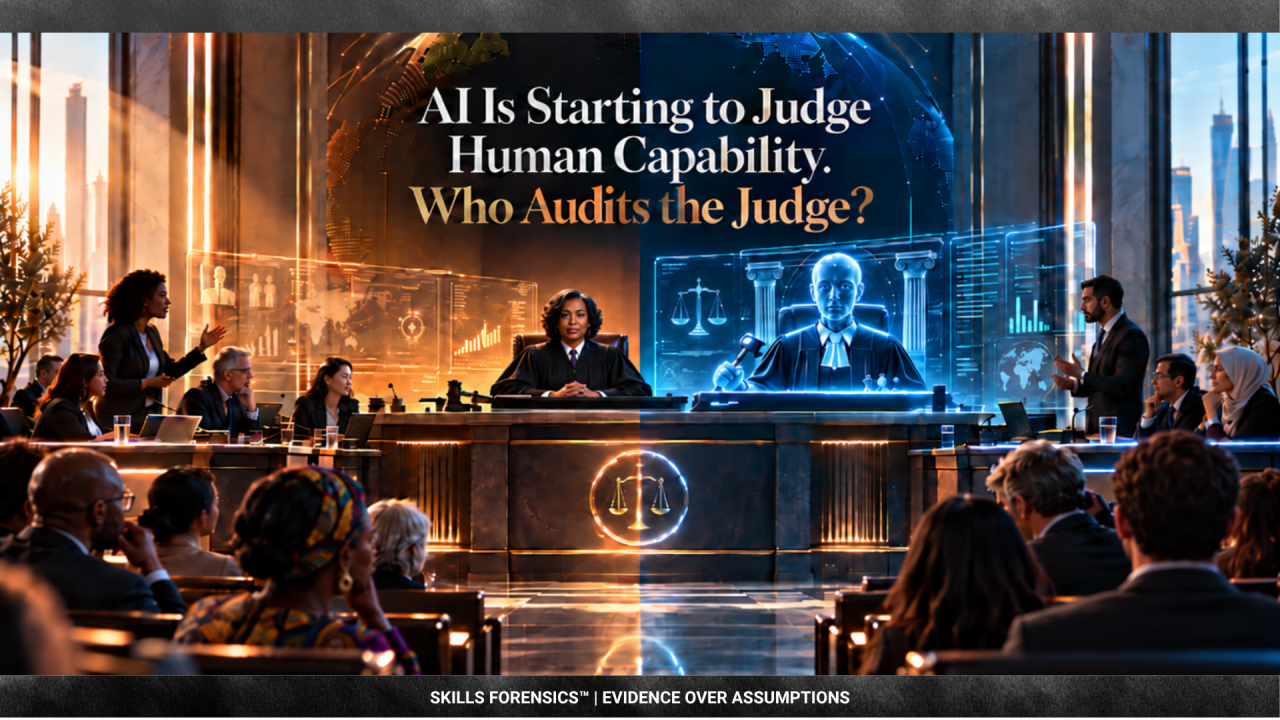
We’re letting AI help decide who gets hired, who gets promoted, who looks capable, and more and more, who’s worth the money. Before we slap a “progress” label on that, let’s finally ask the question we’ve dodged for decades: who the hell proves the judge is qualified to make the call?
This week, Dr. Blake Curtis, Sc.D sent me a certificate for writing the foreword to his new book, Cybersecurity & AI Auditing. The wording jumped out at me. It called out my perspective on workforce capability and assurance, two ideas that keep crashing into each other in my head. Blake and I have spent years debating what happens when organizations mix up records with reality, activity with actual capability, and compliance with something you can truly trust. He comes at it through the cybersecurity and audit lens. I keep running into the same mess with people.
I’ve been watching organizations screw this up since the days of phone-line modems. One of my first sales jobs was selling dial-up and DSL for a Pittsburgh ISP. Our help desk was obsessed with certifications. Someone would show up with the right acronyms, the right test scores, the right piece of paper, and sometimes be gone within a week because the real job exposed what the credential never could. Turns out, being great at studying for a test isn’t the same as being good at the work. Who knew?
Thirty years later, we’ve built a juggernaut credentialing economy on that same shaky logic. Certifications, badges, course completions, résumé keywords, endorsements, and assessments all have their place, but we keep asking them to prove more than they ever could. I’m not anti-credential. I’m anti-bullshit. A credential means something happened. Whether it proves the capability that actually matters is another story.
Now we’re putting AI in the judge’s chair. The old problem doesn’t vanish. It just gets harder to spot.
Automating an Assumption Does Not Turn It Into Proof
McKinsey & Company is test-driving an AI client simulation in some entry-level consulting interviews. Candidates talk to an AI-generated client while humans watch how they handle the curveballs. The AI doesn’t make the hiring call; humans still do. I like the direction. It is a step toward watching someone wrestle with messy, real work rather than rewarding whoever memorizes the most polished interview answers.
But there’s an itch I can’t ignore: what proves the person judging the performance actually knows what they’re seeing?
I’ve had sales leaders judging me who, frankly, I believed I was more capable than they were in parts of the work they were supposed to assess. That is not an insult. It is just reality, and anyone who has been around long enough has probably lived some version of it. We quietly treat title, authority, seniority, or proximity to the work as stand-ins for knowing how to judge someone else’s capability. Sometimes that works. Sometimes the org chart is doing a hell of a lot more heavy lifting than the evidence.
AI puts a spotlight on that weakness because now the judge might be part machine. We are already seeing AI used to read résumés, screen candidates, generate interview environments, interpret evidence, and support decisions. At the same time, candidates are using AI to improve the very evidence those systems are reviewing. That creates a strange loop: AI helps create the story, AI helps interpret the story, and everybody hopes the machinery can distinguish polished presentation from actual capability.
We have spent decades trying to improve the evidence about the person being assessed while barely stopping to ask whether the judge is any good.
Automating an assumption doesn’t turn it into proof. It just hides the same old cracks under a shinier surface.
None of this means humans are magically unbiased. We’re the source material. Our history, language, judgments, and blind spots helped build the systems now judging us. My concern is simpler than the usual AI ethics handwringing. If a decision can change someone’s career, income, access, or reputation, the machinery making that call should have to earn our trust. Whether the assessor has skin, silicon, or both should not change the standard.
An assessment does not suddenly become objective just because AI leaves fingerprints on it. All it does is give us one more part of the decision that deserves a hard look.
Stop Measuring Humans Against AI. Measure Both Against the Work.
The human-versus-AI debate has always felt like it is playing in the shallow end. Usually, it starts with “Who is better?” before anyone bothers to define “better at what, exactly?” Better at which work? How difficult is the task? How much autonomy is required? What happens when everything goes sideways? What would convince us the result was real and not dumb luck?
Without those questions, most human-versus-AI comparisons are theater. They make fun headlines, but they tell us very little about capability.
This is why I keep talking about SFIA, the Skills Framework for the Information Age, and the non-profit SFIA Foundation. SFIA gives us a shared language for describing work through observable activities and seven levels of responsibility that account for things like autonomy, influence, and complexity. It lets organizations talk about capability without hiding behind job titles, credentials, or the old “years of experience” crutch.
As AI becomes part of the workforce, that gives us something we desperately need: a common playing field.
Stop measuring humans against AI. Measure both against the work. That is the only score worth keeping.
If the requirement is the requirement, why should the language change depending on whether the performer is biological or digital? Can the human do the work? Can the AI agent do it? Can the human do it better with the AI? Can the AI operate safely without the human? What happens when the context changes, the pressure goes up, or the obvious answer turns out to be wrong? And what evidence supports each claim?
At SkillsTX, this is no longer some thought experiment. TalentTX gives organizations a structured view of workforce capabilities, and AI agents can now sit within that same workforce and project-planning picture. Humans and AI can start being described against the same work language instead of pretending they belong on completely different scoreboards.
That is powerful. It is also where I start asking harder questions.
Putting a human and an AI on the same skills map does not mean either one can do the job. A dashboard can make both visible. Visibility is useful. Visibility is not proof.
If a system says John and an AI agent are both lined up with the same requirement, I want to know why. Show me the work that backs it up. Show me whether it happens again. Show me what breaks when the conditions change. Show me what help was in the mix and what falls apart when you take it away. If the best outcome only shows up when humans and AI work together, stop forcing the story so all the credit goes to one side.
That is where Skills Forensics™ keeps pulling me. I care less about slapping skill labels on people and more about what the evidence actually allows a decision maker to defend as true. Those sound like similar questions until real money, risk, or somebody’s career is on the line.
If the business decision hangs on capability being real, visibility is not enough. Show me the damn evidence.
The Chasm Between Compliance and Assurance
Blake’s book landed at exactly the right moment because assurance has become one of the words I care about most. My friends at the DVMS Institute have been pushing the same distinction from the governance side. Their Governance by Assurance work urges organizations to move beyond policies, periodic reviews, and compliance artifacts toward evidence demonstrating whether the organization is operating as leadership believes it is.
There is a giant chasm between compliance and assurance, and that difference can feel academic right up until something blows up. Then it becomes everything.
A completed course might check a compliance box while telling me very little about whether someone can perform under pressure. A documented control can look gorgeous right up until the first ugly exception. A workflow can brag about having a “human in the loop” without anyone establishing whether that human has the knowledge, experience, or authority to catch what the AI gets wrong.
In my experience, you still need humans if you do not want a lot of AI output to become slop. Somebody has to spot when the answer is technically polished but commercially dumb, when context is missing, or when the machine is confidently wrong. I also do not think we should romanticize that arrangement as permanent. Technology will get better, the division of labor will move, and some human checkpoints we consider essential today may eventually look as quaint as calculating sales tax by hand.
That is exactly why “human in the loop” cannot become another comforting checkbox.
If the human is the control, who proved the human is actually capable of controlling anything?
We may soon have better records of what an AI agent did, what it touched, and what it decided than we have proof that the human approving its actions was qualified to do so. That should worry us, not because humans are uniquely unreliable, but because trust without proof is always expensive.
That is where workforce strategy, cybersecurity, audit, risk, and AI governance all crash together. The question is no longer simply whether the system works. It is whether the human, the AI, and the combined operating model can be relied on when the stakes are real.
The Conversation Is Not You Versus AI
I am not here to save every human task from automation. Some work should absolutely disappear. Last week, I wrote about how AI has already given me back hours I used to lose in account research and company reports, work that needed to get done but never really needed the best of me. I want more of that. I am not interested in preserving every old job description just because a human used to do the work. I want humans to spend more time where their capability creates value worth fighting to keep.
What worries me is what happens when executives chase the quick efficiency win and assume the spreadsheet captured everything that matters. Institutional knowledge does not have a database field. Neither do trust, relationships, cultural memory, intuition, or the ability to spot the weird edge case because you have been burned by it before. A company can save money this quarter and wake up six months later realizing it automated the visible work while accidentally firing the invisible capability that kept everything running.
That is a brutal way to find out what mattered.
This is not “humans good, AI bad.” Most of me buys the hard-nosed argument that if the work gets done, customers ultimately care about the outcome. But when that outcome affects hiring, promotion, cybersecurity, safety, customer trust, or a financial decision with real consequences, “it worked once” is worthless. I want to know whether it can work again, what made it work, what falls apart when the combination changes, and how much confidence the evidence deserves.
This is where it all clicks for me without becoming a product pitch. SFIA gives us a shared language for the work. TalentTX shows how humans and AI can coexist in the same workforce. DVMS keeps hammering the difference between documented compliance and real assurance. Skills Forensics keeps asking the question beneath all of them: what can we defend as true based on the evidence we have?
That question gets a lot more serious when the thing judging capability is itself intelligent.
Capability assessment gets much more useful when we stop framing the question as human versus machine and start testing both against the requirement and the evidence. Human, AI, or some combination of the two, show me what you can do and what proves it.
And if you are going to judge whether someone else is capable, the evidence ought to prove something about you, too.
#AIGovernance #HumanAI #SkillsForensics
This article was originally authored by John Kleist III and is republished by SkillsTX with his permission. All original authorship, analysis, concepts, and commentary are credited to John Kleist III.
