
September 3, 2026
There is a dramatic difference between assumed capability and defensible capability. Look closely at Raphael’s profile:
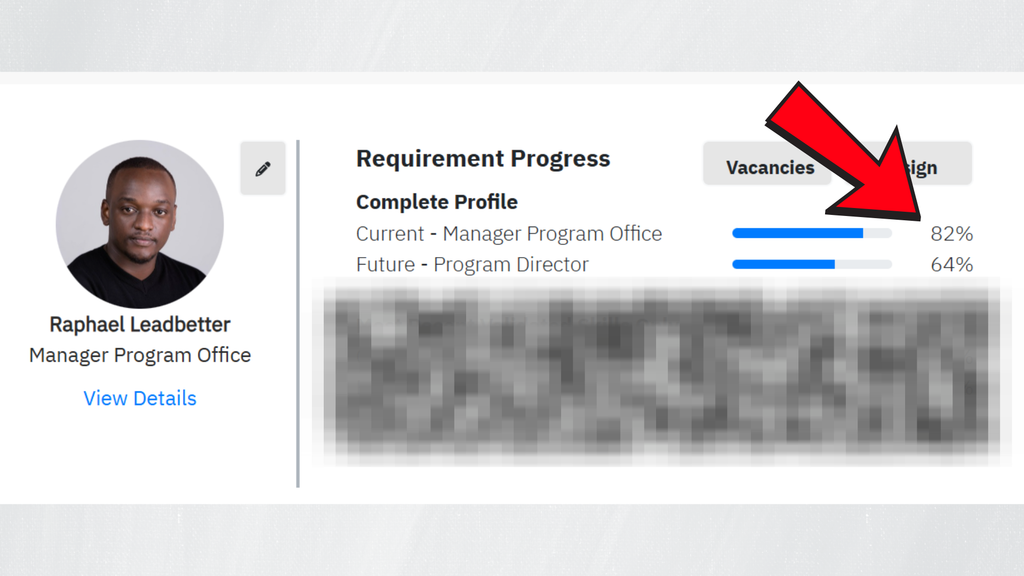
This is what talent platforms are built to show. Raphael is a Manager Program Office. His profile says he is an 82% match for his current job. For the next role he’s interested in, Program Director, he is already at 64%. That sounds pretty healthy.
If I am Raphael, I feel good about where I am headed. If I am his manager, I see someone on track for the next role. If I am in HR, I have data that appears to support workforce planning, succession, mobility, and development. Then we change one setting.
Most Recent Validated Skills Only.
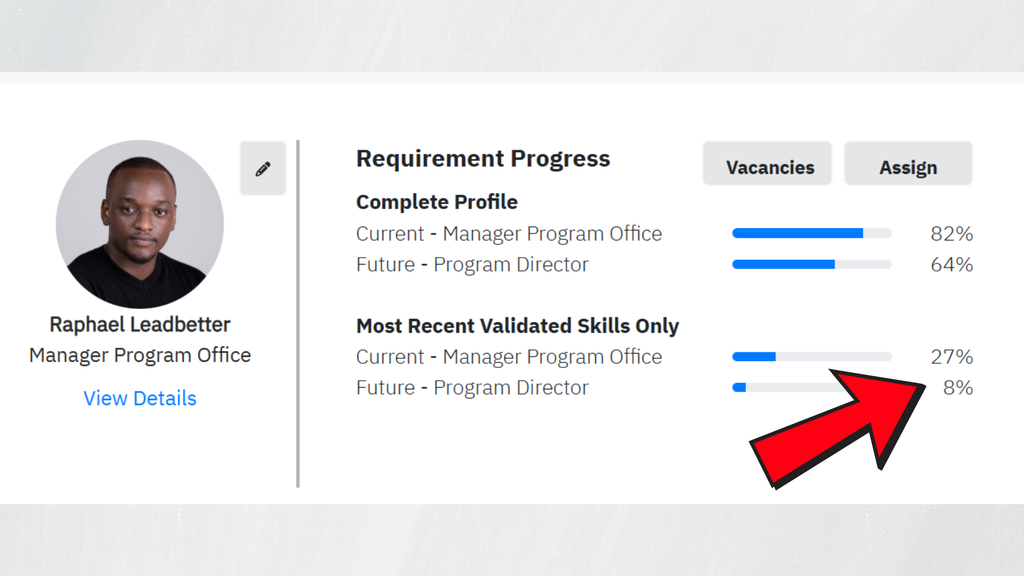
Raphael’s current-role match falls from 82% to 27%. His 64% future-role match falls to 8%.
Same person. Same roles. Same organization. Completely different answer.
And that 55-point gap in his current role is one of the clearest examples I have seen of what I mean by Skills Forensics™.
Here is the thing. This does not prove Raphael lacks those other skills. That would be the wrong conclusion. It proves something more important.
We cannot actually substantiate enough of these skills with validated evidence.
HRIS, LMS, talent marketplaces, skills platforms are all getting better at assembling signals. Job history. Titles. Courses. Certifications. Manager input. Self-declared skills. Résumé data. Project history. AI inference. Sometimes even skills inferred from other inferred skills.
Stack enough of those signals and the system spits out a precise-looking percentage.
Here is the problem. Precision in the calculation does not equal credibility in the evidence.
We have spent years asking technology:
What skills do we think this person has?
Skills Forensics™ asks, “What skills can we actually establish they have, at the level required, and what evidence supports that conclusion?”
That is a radically different standard.
This is where SFIA (the Skills Framework for the Information Age) gets powerful. A skill is not just something you have or do not have. Capability lives at a level of responsibility: autonomy, influence, complexity, knowledge, business skills. That lets us move past keyword matching and actually ask: can this person apply the skill at the level the work demands?
Now go back to Raphael.
His complete profile indicates strong alignment with his current role. His validated profile indicates a significant evidence deficit behind that alignment.
That 55-point gap does not mean Raphael needs training. He could be highly capable. Some of the missing evidence may never have been captured, validated, or even connected to his profile.
That distinction matters enormously.
Because there are a few key possible findings hiding inside the gap.
- Raphael may possess those capabilities, but the organization cannot currently demonstrate them. That is an assurance risk.
- Or Raphael may have capability the system has never detected. That is untapped potential.
This is where it gets uncomfortable.
Imagine Raphael is not managing an ordinary internal program. Imagine he is responsible for a major cybersecurity transformation, regulated infrastructure, healthcare technology, financial systems, defense work, or an AI deployment that makes consequential decisions.
Something goes wrong. An auditor, regulator, insurer, or plaintiff’s attorney asks a very simple question:
Why did you believe Raphael was qualified to perform this work?
The organization produces its talent system.
“His match was 82%.” Fine. Show me what the 82% was based on.
That is where the conversation changes.
- Was it based on demonstrated application of the skills?
- Was proficiency assessed against a recognized standard?
- Was there observable workplace evidence?
- Did somebody competent validate it?
- When was it validated?
- At what level?
Or was the match substantially constructed from job titles, learning completions, credentials, self-reporting and algorithmic inference?
Those signals can all be useful. But they are not interchangeable with proof.
And I think we are dramatically underestimating the governance implications of that distinction.
For years, organizations have spent millions building systems that tell executives what their workforce supposedly knows. We now have AI powerful enough to infer thousands of skills across enormous populations almost instantaneously.
That sounds like progress. On the surface.
Unless all we have done is become extraordinarily efficient at scaling assumptions.
In the age of machine intelligence, organizations are about to make enormous decisions about hiring, reskilling, redeployment, automation, and workforce reduction, increasingly based on skills data. That makes the provenance of the data matter. A lot.
This is why I do not see Skills Forensics™ as just another HR methodology or assessment product.
I see it as a new discipline: workforce assurance.
- Start with the claim.
- Trace the evidence.
- Establish the standard.
- Determine the required level.
- Test what can actually be substantiated.
- Separate knowledge from demonstrated proficiency.
- Separate inferred capability from validated capability.
- Identify both the exposure and the hidden potential.
Then make the workforce decision.
The SkillsTX model is built on a simple progression. Know what skills you actually have. Know what you need. Expose the unknown gaps. Turn those gaps into deliberate development or workforce action. Not an assumption.
Raphael’s example makes the concept visible.
82% complete-profile match. 27% using validated skills.
That 55-point gap is not about Raphael. It is a question for the organization. What exactly lives inside those 55 percentage points?
- Missing skill?
- Missing evidence?
- Outdated validation?
- Incorrect role requirements?
- Unrecognized capability?
Or assumptions that have simply been repeated long enough that everybody started treating them as fact?
Now multiply Raphael by 1,000 employees. 10,000. 100,000.
Then layer those assumptions into hiring, promotions, compensation, succession planning, layoffs, outsourcing, AI transformation, cyber risk, and regulated work.
That is why I believe the Skills Assumption Conundrum is actively moving out of HR and into board-level conversations about risk, audit, governance, and legal matters.
Because when somebody finally puts enterprise skills data under a genuine forensic scope, the most dangerous gap may not be between the skills your people have and the skills they need.
It will likely be the gap between what your organization says is true and what it can actually prove.
That is Skills Forensics™.
