September 25, 2026
My son Brandon is a freshman in college, and recently he was asked to create his first résumé. He has barely started building a career, but right near the top of the template was a section waiting to be filled in: Certifications. I looked at that for a minute because it perfectly captures something I have been thinking about for years. Before people even enter the workforce, we teach them that one of the primary ways to prove what they can do is by collecting credentials.
I am hardly in a position to throw stones. I have plenty of letters and logos myself. Over a 30-year career in technology, sales, and marketing, I have accumulated certifications in ITIL, COBIT, ISO standards, Business Relationship Management, and more. I earned my A+ and Microsoft Certified Professional credentials in the early 2000s, and because of the rules at the time, I am still grandfathered into both. Those certifications could still help me get an interview for certain technical roles.
There is only one small problem: I may have absolutely no business doing the actual job.
That is not an attack on certification. Passing a legitimate exam tells us something. It can demonstrate knowledge at a particular moment in time. But somewhere along the way, talent management got remarkably comfortable allowing evidence of knowledge to quietly become evidence of proficiency, and then allowing proficiency to become competence. Those are not the same thing. Knowing how something works, being able to perform it, and being able to perform it repeatedly at the required level in a real operating environment are very different claims.
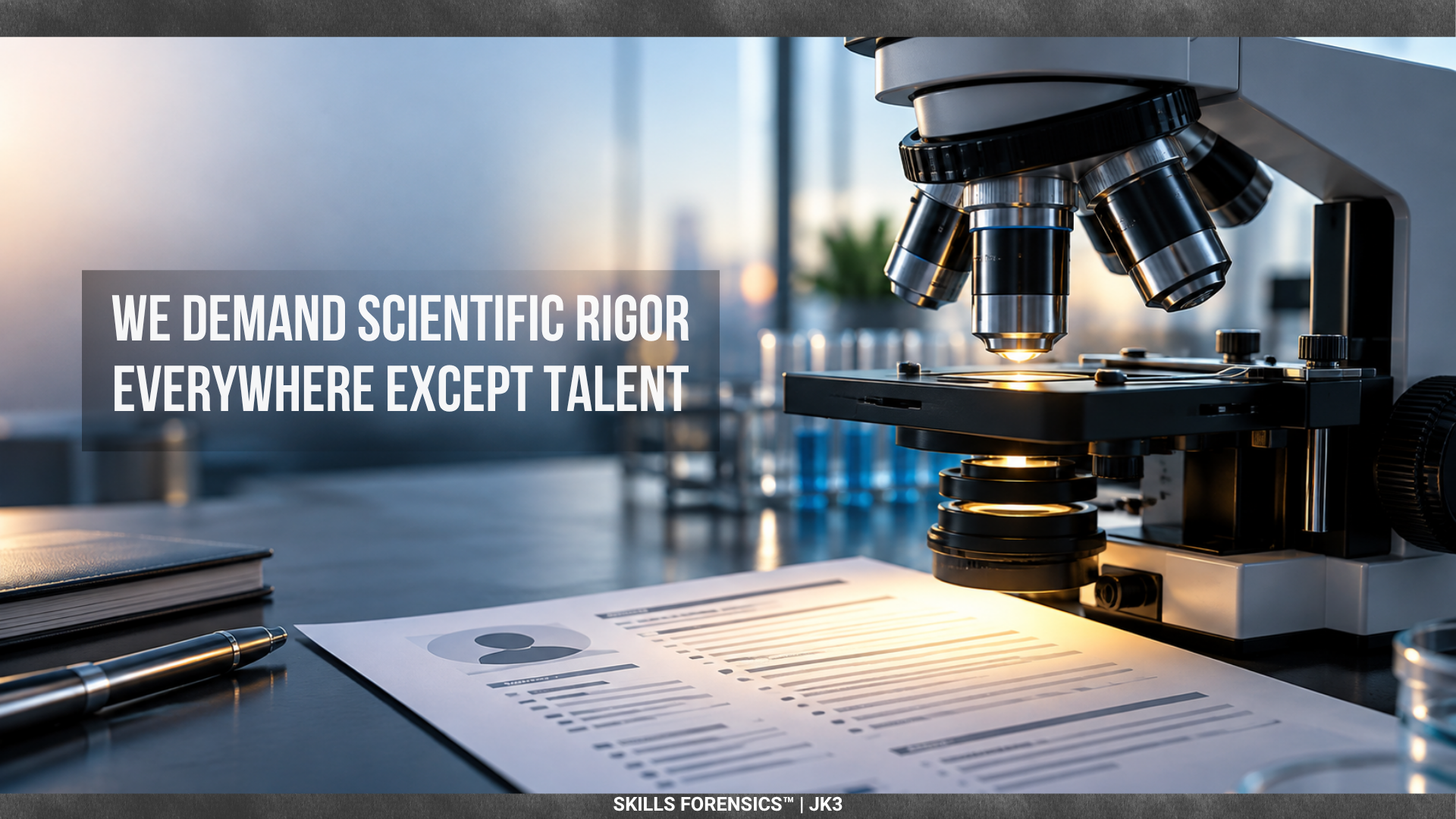
What fascinates me is how little tolerance we have for this kind of leap anywhere else. Imagine pharmaceutical research operating this way. A few promising indicators appear, somebody builds a dashboard, the numbers look good, and we declare the drug effective. That would be absurd. We expect methodology. Controls. Clear definitions. Reproducibility. Evidence strong enough to support the conclusion. We expect researchers to distinguish between what they observed and what they can legitimately infer from it. Yet inside organizations we routinely combine self-assessments, manager ratings, training completions, certifications, job titles, and years of experience and call the result a picture of workforce capability.
Maybe it is right. That is the uncomfortable part.
I am not arguing that most organizational talent data is wrong. I am arguing that, in many cases, we have no idea how right it is. There may be an enormous amount of useful evidence sitting inside those systems, but evidence is not the same thing as proof. A polished dashboard cannot make weak evidence stronger, and adding ten weak indicators together does not magically produce scientific certainty. One of the ideas I keep coming back to as I develop Skills Forensics is this:
Scientific rigor is not about collecting more evidence. It is about knowing what the evidence actually allows you to prove.
Now put that problem in front of a board. Organizations are making decisions about workforce transformation, succession, investment, outsourcing, capability gaps, and, increasingly, the movement of human work to AI. We are being told that agentic systems can absorb tasks, reshape roles, and radically alter workforce requirements. I believe much of that is coming. AI will also create staggering efficiency gains. But there is an obvious question buried underneath all of it: how confidently did we understand the human capability we are replacing in the first place?
That question gets even more interesting when organizations are encouraged to pour their existing talent data into an AI-powered platform and let the machine tell them which skills they have, which they need, and what to do next. The technology may be extraordinary. The input data may still be a collection of assumptions. AI can process bad evidence at breathtaking speed. It can discover patterns inside it. It can make the output look incredibly sophisticated. None of that changes what the underlying evidence actually proves.
This is why skills and workforce data will become much bigger than just an HR conversation. Boards should care. Governance, risk and compliance leaders should care. Strategic workforce planners should care. Anyone making material decisions about where humans end, and AI begins should care. If workforce capability increasingly influences business continuity, transformation risk, and strategy execution, then the evidence supporting those capability claims deserves scrutiny much closer to what we already expect in other consequential disciplines.
I am actually a huge believer in where this can go. I want the dashboards. I want real-time workforce intelligence. I can absolutely imagine a time when leaders have something approaching real-time workforce assurance rather than another annual skills survey. But if we are going to use the term “assurance”, then we have to earn it. The underlying data has to become more current, more auditable, more transparent about uncertainty and much clearer about the difference between evidence, inference and actual demonstrated capability.
Sometimes the scientifically rigorous answer may be that someone is competent. Sometimes there is a genuine capability deficit. And sometimes the answer may be: we do not have enough evidence to know yet.
I would rather put that answer in front of a board than manufacture certainty that does not exist.
Because if we cannot explain the difference between knowledge, proficiency, and competence, we probably have no business calling our skills data “scientific”.
#SkillsForensics #ScientificRigor #FutureOfWork
This article was originally authored by John Kleist III and is republished by SkillsTX with his permission. All original authorship, analysis, concepts, and commentary are credited to John Kleist III.
